Ukraine Endures Record-Breaking Aerial Assault Targeting Cities Far West
Reporting for 24x7 Breaking News, we are tracking an extraordinary escalation in the conflict, as Russia unleashed what military analysts are calling one of the largest single-day aerial assaults of the war, specifically targeting civilian centers across Ukraine, including the historically rich western regions. This massive wave of drone strikes, which included over 400 unmanned aerial vehicles (UAVs) fired during the unusual afternoon hours on Tuesday, resulted in immediate civilian casualties and significant structural damage.
- Ukraine Endures Record-Breaking Aerial Assault Targeting Cities Far West
- Cultural Heritage and Civilian Infrastructure Under Coordinated Fire
- Geographic Shift Signals New Strategic Calculus
- A HUMANITARIAN PERSPECTIVE: The Erosion of Normalcy
- THE REAL-WORLD IMPACT: Economic Shockwaves Far From the Front
- Frequently Asked Questions (FAQ)
- What makes this drone attack different from previous assaults?
- Was a UNESCO World Heritage site confirmed damaged?
- What is the current casualty status from the daytime strikes?
The sheer scale of the attack challenges previous operational patterns, forcing Ukrainian air defenses to stretch resources across a broad geography. Yurii Ihnat, spokesman for the Ukrainian Air Force, confirmed late Tuesday that a “large number of drones” entered Ukrainian airspace from the north, moving in coordinated “columns.” He stressed that the daytime targeting breadth was wider than typical nighttime operations, classifying the event as one of the most intense 24-hour periods since the full-scale invasion began four years ago.
Cultural Heritage and Civilian Infrastructure Under Coordinated Fire
The impact in Lviv, a city often considered relatively secure compared to eastern frontlines, was devastating. Mayor Andriy Sadovyi reported that at least 22 individuals required medical attention, with officials warning that the injury toll would certainly climb as search and rescue operations continued. The damage extended beyond residential areas, striking directly at irreplaceable cultural assets.
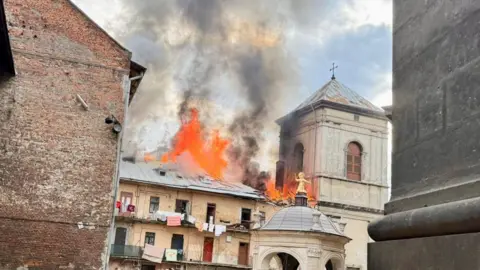
Maksym Kozytskyi, the head of the Lviv region, confirmed that the Bernardine monastery, a venerable 16th-Century site recognized by UNESCO, sustained damage. We saw harrowing footage circulated by local authorities showing intense fire consuming the roof structure near the historic landmark, a stark reminder that no place seems truly sacred under this sustained campaign of terror. This deliberate targeting of sites of historical significance raises serious questions about adherence to international norms, echoing broader concerns about systemic violations we've seen globally, such as the escalating displacement caused by actions like those reported in [Israel Declares 30km Buffer Zone in South Lebanon, Forcing Massive Displacement](https://24x7-breakingnews.blogspot.com/2026/03/israel-declares-30km-buffer-zone-in.html).
Further west, the consequences were equally tragic. In the Ivano-Frankivsk region, Svitlana Onyshchuk, the regional head, reported that two residents were killed, including a six-year-old child, alongside four other injuries. Damaged facilities included general city buildings and, tragically, a maternity hospital, showing the indiscriminate nature of these strikes.
Geographic Shift Signals New Strategic Calculus
The strategic angle here demands attention from defense analysts. While the war has scarred virtually every corner of Ukraine, the western cities—Ivano-Frankivsk, Vinnytsia, and Ternopil—have historically absorbed less frequent and intense bombardment than those near the Russian border. Tuesday’s coordinated, high-volume daytime assault signals a potential strategic pivot.
Why now? Our editorial team assesses this move as an attempt to force Kyiv to divert critical air defense assets away from the crucial eastern sectors and infrastructure hubs. When one side utilizes such overwhelming, resource-intensive tactics, it often signals a desire to test an opponent's logistical breaking point. This tactic seems designed to degrade not only physical infrastructure but also the psychological resilience of populations far removed from the immediate trenches. It speaks volumes about the current state of long-range military coordination.
In Vinnytsia, the afternoon barrage claimed one life and injured eleven people, compounding the overall casualty count that followed a deadly overnight attack which had already claimed at least five lives nationwide. Such continuous pressure suggests an intent to keep the entire nation under a constant state of emergency, impacting everything from supply chains to local governance.
A HUMANITARIAN PERSPECTIVE: The Erosion of Normalcy
What concerns us most, as observers dedicated to human dignity, is the absolute destruction of normalcy for millions. When children cannot attend school safely, when a maternity ward comes under fire, the calculation shifts from military necessity to calculated cruelty. We must never normalize the targeting of civilian zones, whether they house ancient monasteries or new families. These are not mere statistics; they are lives shattered, futures interrupted by the relentless sound of drones overhead.
This pattern of widespread, indiscriminate aggression against population centers, regardless of military value, underscores the immense challenge facing international bodies attempting to enforce the rules of engagement. It feeds into a dangerous global trend where established norms are being tested or outright discarded, much like the escalating tensions we've analyzed concerning [The End of Global Order? How the US-Iran Conflict is Shredding the Rules of War Forever](https://24x7-breakingnews.blogspot.com/2026/03/the-end-of-global-order-how-us-iran.html). Every shattered window and every injured child is a profound indictment of the failure to secure lasting peace.
THE REAL-WORLD IMPACT: Economic Shockwaves Far From the Front
For everyday Americans and those watching global markets, these large-scale attacks translate directly into risk premiums and supply chain instability. While this specific attack didn't immediately impact US stock indices, sustained pressure on Ukrainian energy and agricultural output creates ripple effects across global commodity markets. Investors tracking global stability will note this escalation as a major de-risking event for any long-term infrastructure investment in the region.
Moreover, these massive drone deployments require significant logistical commitment. While Russia faces its own internal pressures—we noted reports of Ukrainian strikes causing damage within Russia’s Kursk region, killing one and injuring thirteen—the continuous expenditure on this scale strains economic resources on both sides. For consumers, this translates to continued volatility in sectors sensitive to Black Sea disruptions. We see this pattern of high-stakes, destabilizing action playing out globally, forcing trading blocs to seek stability elsewhere, evidenced by recent moves like the [EU and Australia Ink Historic A$10B Trade Deal to Counter Global Market Volatility](https://24x7-breakingnews.blogspot.com/2026/03/eu-and-australia-ink-historic-a10b.html).
Frequently Asked Questions (FAQ)
What makes this drone attack different from previous assaults?
- The primary differentiator was the sheer volume—nearly 1,000 drones over 24 hours—and the highly unusual nature of sustaining a massive offensive during daylight hours, significantly challenging air defense response times across a wide area.
Was a UNESCO World Heritage site confirmed damaged?
- Yes, regional authorities confirmed damage to the 16th-Century Bernardine monastery in Lviv, a site designated by UNESCO, according to reports cited by our team, drawing international concern over cultural protection.
What is the current casualty status from the daytime strikes?
- Casualty figures are still rising, but initial reports confirmed fatalities in the Ivano-Frankivsk region and numerous injuries across Lviv and Vinnytsia, emphasizing the immediate human cost of the unprecedented drone barrage.
The decision by Moscow to launch such a sweeping, daytime aerial offensive across Ukraine, striking even deep into the western regions and damaging a Unesco cultural site, fundamentally alters the perceived operational envelope of this conflict. It demands an immediate, unified response to protect civilian life and heritage.
Given the proven capacity to sustain such massive, multi-vector attacks, how long can Ukrainian air defenses realistically hold the line without significantly greater international materiel support?This article was independently researched and written by Hussain for 24x7 Breaking News. We adhere to strict journalistic standards and editorial independence.
Comments
Post a Comment