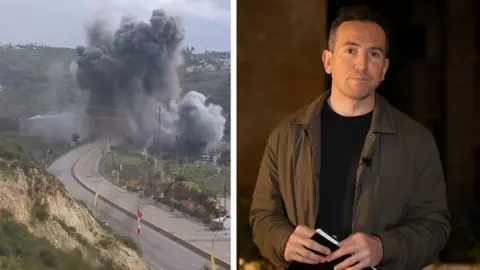
Unilateral Security Zone Declared: Israel Seizes Control Deep Inside Lebanon
Reporting for 24x7 Breaking News, the escalation on the northern front has dramatically intensified after Israeli Defence Minister Israel Katz announced an immediate, unilateral move to seize operational control over a significant swath of southern Lebanon. This strategic maneuver establishes a new, 30-kilometer defensive buffer zone stretching up to the Litani River, effectively barring displaced Lebanese residents from returning until Israel's northern communities are declared safe from militant threats.
- Unilateral Security Zone Declared: Israel Seizes Control Deep Inside Lebanon
- The Litani River as a New Strategic Front Line
- Human Cost Mounts Amid Infrastructure Destruction
- The Failed Promise of the 2024 Ceasefire
- Echoes of History: The Ghosts of Past Buffer Zones
- THE REAL-WORLD IMPACT: Supply Chains and Consumer Confidence
- EDITORIAL PERSPECTIVE: Questioning the Calculus of Displacement
- Frequently Asked Questions (FAQ)
- What is the significance of the Litani River in this new buffer zone?
- What has the official Lebanese response been to Israel's action?
- How does this compare to previous Israeli military deployments in Southern Lebanon?
Katz confirmed that the Israel Defense Forces (IDF) had already executed critical infrastructure strikes, specifically destroying five bridges crossing the Litani River. According to the Minister, these structures were vital conduits utilized by Hezbollah for moving fighters and weaponry into position. This aggressive action follows heightened rocket fire from the Iranian-backed group, which retaliated following the killing of Iran's supreme leader, despite an existing, fragile ceasefire agreement.
The Litani River as a New Strategic Front Line
The scope of this operation mirrors the tactics employed previously in the Gaza Strip, particularly around population centers like Rafah and Beit Hanoun. Katz explicitly stated the intent is "to create a defensive space and keep the threat away." This isn't merely a border patrol; it's an active military maneuver to establish a deep defensive line, eliminating what Israel terms 'terrorist infrastructures' and associated structures near the border.
The ramifications for the local populace are devastating. Thousands of Lebanese citizens, primarily residing in the Shia heartland that serves as Hezbollah's primary support base, are now refugees, explicitly forbidden from crossing back south of the Litani River. We came across this initial reporting via an unknown source domain, but the severity of the announcement by Minister Katz demands immediate global scrutiny.
Human Cost Mounts Amid Infrastructure Destruction
The human toll in Lebanon since the initial escalation following the October 7th attacks continues to climb grimly. According to the Lebanese health ministry, the conflict has resulted in 1,072 fatalities. Disturbingly, this figure includes at least 121 children and 42 health workers. Over a million people are now displaced, exacerbating an already catastrophic humanitarian situation within the nation.
For Israeli residents in the north, this move aims to guarantee their safety. Many had only recently returned to their homes after a prolonged period of evacuation caused by consistent Hezbollah rocket barrages. Forcing another mass evacuation would represent a significant political and social failure for the Israeli government, one that officials are clearly trying to preempt through this forceful security measure.
The Failed Promise of the 2024 Ceasefire
The context of this crisis is rooted in the 2024 ceasefire agreement, which was supposed to mandate Hezbollah's disarmament and withdrawal from southern positions, supervised by the Lebanese government and army. Progress was partial at best, as the Lebanese state has long lacked the internal capacity—and arguably the political will—to confront Hezbollah directly, fearing a descent back into civil strife.
Israel Katz argued that this military action is necessary because the Lebanese government had done "nothing" to enforce the terms. Conversely, Lebanon's President Joseph Aoun has vociferously denounced the Israeli plan, labeling it "collective punishment against civilians." This distinction between state failure and collective reprisal lies at the heart of the current international debate.
Echoes of History: The Ghosts of Past Buffer Zones
The concept of a long-term, Israeli-enforced security zone in southern Lebanon is not new, immediately raising alarms for those who remember the 1985 zone, which Israel eventually maintained until 2000. That previous occupation ended largely due to the attrition Hezbollah inflicted upon Israeli forces, leading to significant domestic opposition back home.
Hezbollah officials have already signaled their intent to resist this new incursion fiercely. Hassan Fadlallah, a senior official within the group, characterized the Israeli move as an "existential threat." He issued a stark warning, stating, "We have no choice but to confront this aggression and cling to this land." This sets the stage for potentially intense ground conflict within the newly declared zone.
THE REAL-WORLD IMPACT: Supply Chains and Consumer Confidence
While the immediate focus is regional security, we must analyze the ripple effects on global commerce and stability. Escalation in this vital corridor threatens shipping lanes and regional energy markets. Investors watch these geopolitical flashpoints closely, as heightened tensions often correlate with increased volatility in oil prices, similar to what we analyzed concerning global oil markets exploding above $100 in related economic instability.
For the average American consumer, this means continued uncertainty. While seemingly far removed, prolonged conflict in the Levant pressures commodity markets and increases defense spending obligations for allied nations. This kind of sustained regional instability often complicates international trade agreements, such as the recent pacts aimed at stabilizing trade, like the EU and Australia Ink Historic A$10B Trade Deal, by injecting unpredictable risk premiums across the board.
EDITORIAL PERSPECTIVE: Questioning the Calculus of Displacement
In our view as senior editors committed to human dignity, the decision to institutionalize displacement as a security mechanism is profoundly troubling. Security for one population cannot ethically be purchased through the forced exile and suffering of another. While we understand the imperative to protect Israeli citizens from rocket attacks—a reality that has shattered communities—the strategy employed here, which deliberately renders over a million people stateless within their own country, crosses a moral line.
This unilateral act signals a breakdown in diplomatic architecture and a frightening retreat toward purely kinetic solutions. It suggests that international mechanisms, including those established following the 2024 agreement, have completely failed. When nations resort to creating vast, controlled buffer zones modeled on past conflicts, it often locks in cycles of violence for decades. We see parallels here to larger systemic breakdown, perhaps even hinting at the end of global order as established norms are discarded for immediate, localized military advantage.
What we are witnessing is the weaponization of geography against civilian populations, regardless of the stated military objective. True, lasting security can only emerge from negotiated settlements that respect the rights of all people living in the contested area, not through the erasure of existing communities. The precedent set by declaring entire zones off-limits to their original inhabitants is dangerous for every border region worldwide.
Frequently Asked Questions (FAQ)
What is the significance of the Litani River in this new buffer zone?
- The Litani River is located approximately 30 kilometers (19 miles) from the recognized border, marking the northern extent of Israel's declared security zone.
- Israel destroyed five bridges over the river to disrupt Hezbollah's logistical supply lines moving fighters and weapons.
What has the official Lebanese response been to Israel's action?
- Lebanon's President Joseph Aoun strongly condemned the plan, characterizing the creation of the zone and the related displacement as an act of "collective punishment against civilians."
- Hezbollah has vowed to confront the Israeli forces actively occupying the territory, calling it an "existential threat."
How does this compare to previous Israeli military deployments in Southern Lebanon?
- The current plan strongly echoes the buffer zone Israel maintained in Southern Lebanon from 1985 until its withdrawal in 2000.
- The previous withdrawal was heavily motivated by sustained casualties inflicted by Hezbollah, leading to domestic political pressure in Israel.
The strategic repositioning, involving the destruction of critical infrastructure to enforce the Israel-Lebanon security zone, signifies a dangerous pivot toward entrenched military occupation rather than de-escalation.
Given the high human cost and the historical precedent of failed buffer zones, what realistic diplomatic off-ramp exists to prevent this confrontation from spiraling into a full-scale regional war where civilians pay the ultimate price?This article was independently researched and written by Hussain for 24x7 Breaking News. We adhere to strict journalistic standards and editorial independence.
Comments
Post a Comment