The Thermodynamic Breaking Point: Why the UN Is Flashing Red
Reporting for 24x7 Breaking News — The World Meteorological Organization (WMO) has issued its most dire warning to date, revealing that the Earth’s climate limits are being breached at a rate that defies historical precedent. In a comprehensive report released this week, the UN’s weather agency confirmed that our planet is currently trapped in a record "energy imbalance," absorbing significantly more heat energy from the sun than it can release back into space. This fundamental shift in the planet's metabolism is being driven by the relentless accumulation of greenhouse gas emissions, particularly carbon dioxide, which has now reached levels not seen on Earth for at least two million years.
- The Thermodynamic Breaking Point: Why the UN Is Flashing Red
- The Silent Reservoir: 90% of Our Excess Heat Is in the Ocean
- National Security and the Fossil Fuel Divorce
- Economic Fallout: The Kitchen-Table Reality of a Warming World
- Our Editorial Perspective: The Systemic Failure of Incrementalism
- Frequently Asked Questions (FAQ)
- What is the 'energy imbalance' the UN is warning about?
- How will the upcoming El Niño affect global temperatures?
- Why are ocean heat records so important?
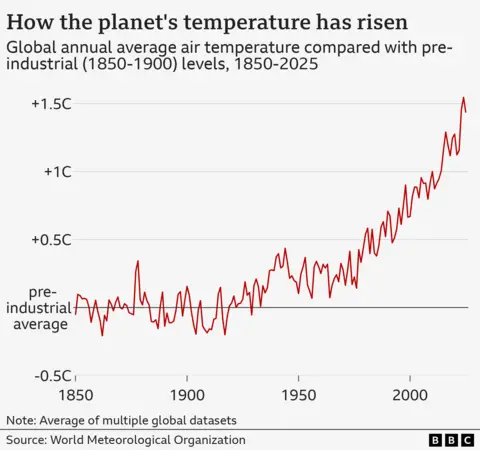
We have watched the data trickle in for decades, but the 2025-2026 window represents a terrifying acceleration. According to WMO Secretary-General Prof. Celeste Saulo, human activities are increasingly disrupting the natural equilibrium of the globe, creating consequences that will reverberate for hundreds, if not thousands, of years. The report highlights that the last 11 years were the warmest since records began in 1850, with 2025 seeing global average air temperatures hover approximately 1.43°C above pre-industrial levels. This isn't just a statistical anomaly; it is a systemic failure of our planetary life-support systems.
While 2025 was slightly moderated by the cooling effects of a natural La Niña cycle, it remained one of the three warmest years on record. Now, the scientific community is bracing for the impact of a looming El Niño phase, expected to take hold in the second half of 2026. Experts like Dr. John Kennedy of the WMO warn that this natural warming event, layered on top of the background human-caused warming trend, could push global temperatures to catastrophic new heights by 2027. We are no longer just talking about warm summers; we are talking about a permanent shift in the baseline of human existence.
The Silent Reservoir: 90% of Our Excess Heat Is in the Ocean
Perhaps the most chilling revelation in the WMO report is where all this trapped energy is going. While we feel the heat on our skin during record-breaking heatwaves, more than 90% of the Earth’s extra energy is being absorbed by the oceans. The heat stored in the upper 2km of the global ocean reached a new peak last year, warming more than twice as quickly over the last two decades as it did during the late 20th Century. This massive thermal injection is effectively a ticking time bomb for marine ecosystems, storm intensity, and sea-level rise.
As the oceans warm, they expand, and they fuel increasingly violent weather patterns. We are seeing this play out in real-time. In the Southwest United States, a record-breaking early-season heatwave has seen temperatures soar past 40°C—nearly 15°C above seasonal averages. Scientists at the World Weather Attribution group have already concluded that such intensity would have been "virtually impossible" without human-caused climate change. This isn't just about the weather; it's about the very infrastructure of our lives. For instance, even the way we design high-performance machinery, such as Subaru’s new sports office projects, must now account for extreme thermal stress that was unheard of twenty years ago.
The melting of the planet's ice caps and glaciers is the other side of this coin. Provisional data for the 2024/25 period indicates that the world’s glaciers suffered one of their five worst years on record. Sea ice at both poles remained at or near record lows throughout most of 2025. This loss of 'whiteness' at the poles creates a feedback loop: as white ice disappears, it is replaced by dark ocean water, which absorbs even more heat, further accelerating the global energy imbalance. It is a cycle that we are currently failing to break.
National Security and the Fossil Fuel Divorce
UN Secretary-General António Guterres has been typically blunt in his assessment, calling for an immediate and total shift away from fossil fuels. He argues that moving to renewable energy is no longer just an environmental necessity but a prerequisite for "climate security, energy security, and national security." The logic is simple: as long as we remain tethered to the volatile markets of oil and gas, we remain vulnerable to both the physical impacts of climate change and the geopolitical whims of petrostates.
In our view, the intersection of climate change and technology is becoming the new front line of global stability. Much like how the FCC recently banned foreign routers over espionage fears, the transition to a green economy is being viewed through the lens of protectionism and national resilience. If a country cannot control its energy source—or if its energy source is actively destroying its agricultural and coastal infrastructure—it cannot claim to be secure. The WMO report makes it clear that the UN climate warning 2026 is as much a memo to the Pentagon and the Department of Defense as it is to environmentalists.
Economic Fallout: The Kitchen-Table Reality of a Warming World
For the average American, these high-level warnings often feel abstract until they hit the wallet. The real-world impact of a 1.43°C warmer world is already visible in rising homeowners' insurance premiums in states like Florida and California, where the risk of fire and flood has become uninsurable for many. It’s visible in the price of groceries, as erratic weather patterns disrupt crop yields and supply chains. When the UN says the planet is being pushed beyond its limits, they are effectively saying that the era of cheap, predictable resources is over.
Furthermore, the spread of diseases such as dengue fever into previously temperate zones is a direct result of rising temperatures. This places an enormous burden on public health systems that are already stretched thin. We are witnessing a slow-motion collision between our 20th-century economic models and 21st-century physical realities. The ocean heat records being set today are the leading indicators of the economic crises of tomorrow.
Our Editorial Perspective: The Systemic Failure of Incrementalism
At 24x7 Breaking News, we believe it is time to stop treating these reports as mere weather updates. The WMO’s findings represent a profound indictment of a global political class that has prioritized short-term corporate profits over the long-term habitability of the planet. We are currently witnessing a record "energy imbalance" because we have allowed an economic imbalance to persist—one where the costs of greenhouse gas emissions are socialized while the profits are privatized.
What concerns us most is the lack of urgency in the face of "red-flashing" indicators. We see world leaders offer punchy video addresses while simultaneously approving new drilling permits and subsidizing the very industries that are pushing us toward the brink. The humanitarian cost of this hypocrisy is staggering. It is the most vulnerable populations—those who contributed the least to the carbon load—who are currently suffering the most from extreme heat and rising seas. We must demand a radical departure from the status quo. Incrementalism is just another form of denial when the house is already on fire.
The looming El Niño is not just a weather event; it is a test of our collective resolve. If we allow 2027 to become another year of record-breaking heat without a corresponding record-breaking shift in policy, we are essentially conceding the future. We believe that climate security must be treated with the same gravity as a military invasion. The enemy isn't at the gates; it's in the atmosphere, and we put it there ourselves.
Frequently Asked Questions (FAQ)
What is the 'energy imbalance' the UN is warning about?
- The energy imbalance refers to the difference between the amount of solar radiation absorbed by Earth and the amount of infrared radiation emitted back to space.
- Currently, Earth is trapping more heat than it releases, primarily due to greenhouse gases like CO2, leading to sustained global warming.
How will the upcoming El Niño affect global temperatures?
- El Niño is a natural warming of the Pacific Ocean that typically raises global average temperatures.
- Coming on top of human-caused warming, the 2026-2027 El Niño is expected to push the planet toward new, dangerous heat records.
Why are ocean heat records so important?
- The oceans absorb over 90% of the excess heat trapped by greenhouse gases.
- Record ocean temperatures lead to more intense hurricanes, the death of coral reefs, and accelerated sea-level rise through thermal expansion.
The WMO report is a clear signal that Earth’s climate limits are not just being tested—they are being shattered. The question is no longer whether we will see change, but whether we can manage it before it manages us. So here is the real question: If our current political and economic systems are incapable of responding to a 'red alert' for the entire planet, isn't it time we built new ones?
This article was independently researched and written by Hussain for 24x7 Breaking News. We adhere to strict journalistic standards and editorial independence.
Comments
Post a Comment