
A Demographic Crisis Forces a Radical Strategic Pivot
Reporting for 24x7 Breaking News, we have tracked a significant shift in the German labor market that signals a desperate attempt to stave off economic stagnation. As the nation grapples with a plummeting birth rate and an aging baby boomer cohort, the German economy is hemorrhaging talent. To fill the void, the country has begun an aggressive recruitment drive targeting India, aiming to replace retiring tradespeople with a new generation of skilled workers.
- A Demographic Crisis Forces a Radical Strategic Pivot
- From Cold Emails to a Continental Pipeline
- The Human Reality: Seeking Stability Across Borders
- Our Editorial Perspective: A Win-Win or a Systemic Band-Aid?
- Frequently Asked Questions (FAQ)
- Why is Germany struggling to find skilled workers?
- How many Indian workers are currently in Germany?
- What professions are most in need of labor?
- The Future of Global Mobility
This is not merely a localized hiring effort; it is a structural necessity for one of the world's largest economies. According to a 2024 study by the Bertelsmann Foundation, Germany must attract approximately 288,000 foreign workers annually to maintain its current economic output. Without this influx, projections suggest the national workforce could shrink by 10% by 2040, a catastrophic trajectory for any industrialized nation.
From Cold Emails to a Continental Pipeline
The movement began in February 2021 with a simple, unsolicited email. Handirk von Ungern-Sternberg, then working for the Freiburg Chamber of Skilled Crafts, received a message from an Indian employment agency called Magic Billion. The offer was straightforward: India had a massive surplus of motivated, young workers eager for vocational training, and Germany had empty benches in its workshops.
As first reported by the BBC, this initial contact arrived just as German employers reached a breaking point. The butchery trade, in particular, had been in a tailspin; the number of small, family-run shops plummeted from 19,000 in 2002 to fewer than 11,000 by 2021. Joachim Lederer, head of the local butchers' guild, noted that for decades, young Germans had largely abandoned manual trades for white-collar paths, leaving an aging workforce with no successors.
What started as a trial run with 13 recruits has blossomed into a sophisticated recruitment machine. Today, there are 200 young Indians working in German butcher shops alone. Agencies like India Works, founded by Von Ungern-Sternberg and Aditi Banerjee, are currently scaling up to bring 775 additional apprentices into the country this year to fill roles ranging from road building and mechanics to stonemasonry and baking.
The Human Reality: Seeking Stability Across Borders
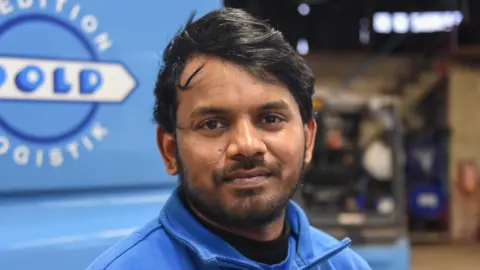
For individuals like 21-year-old Anakha Miriam Shaji and 20-year-old Ishu Gariya, the decision to move to Germany is a calculated pursuit of social security and professional dignity. Gariya, who considered a computer science degree in India, opted instead for a baking apprenticeship in the Black Forest. He cited the cycle of low wages and high competition in his home country as the primary motivation for his move.
These young people are not just filling vacancies; they are seeking a higher standard of living and the stability that comes with a robust social security system. The cultural transition is immense—moving from a bustling Delhi suburb to a quiet, snowy village in southern Germany requires immense resilience. It serves as a reminder that behind every macroeconomic statistic is a person navigating loneliness, cold winters, and the pressure to succeed in a foreign language.
Our Editorial Perspective: A Win-Win or a Systemic Band-Aid?
From our editorial vantage point, this reliance on international labor is a pragmatic solution to a self-inflicted demographic wound. Germany’s failure to incentivize domestic vocational training for its own youth over the last 25 years has created this vacuum. While it is heartening to see young Indian workers finding opportunities to thrive, we must question whether this is a sustainable development model. Are we merely siphoning off the best and brightest from the Global South to keep European industry afloat while ignoring the underlying causes of declining domestic participation?
We believe in the free movement of labor as a human right, but these bilateral agreements must prioritize the well-being of the migrants above the profit margins of the guilds. It is a credit to the resilience of these workers that they have integrated so effectively, but the burden of demographic maintenance should not rest solely on the shoulders of those seeking a better life. We must ensure that these apprentices are not just temporary fixes, but are provided with the long-term support and social inclusion they deserve as future citizens of Europe.
Frequently Asked Questions (FAQ)
Why is Germany struggling to find skilled workers?
- The primary drivers are a low birth rate and the retirement of the baby boomer generation, which has created a massive gap in the labor force that the current younger population cannot fill.
How many Indian workers are currently in Germany?
- Official figures from 2024 indicate there are 136,670 Indian workers in Germany, a significant increase from the 23,320 documented in 2015.
What professions are most in need of labor?
- The demand is widespread across vocational trades, including butchery, baking, road construction, mechanical engineering, and stonemasonry.
The Future of Global Mobility
As the Migration and Mobility Partnership Agreement between India and Germany continues to facilitate the movement of thousands, the economic integration between these two nations will only deepen. The shift toward 90,000 skilled work visas annually demonstrates that Germany has fully embraced this pivot as the only viable path to economic survival. This labor migration is not just a temporary fix; it is a permanent adjustment to a globalized economy where borders are increasingly porous for those with the skills the market demands. Is this reliance on foreign apprentices a masterstroke of economic policy, or is it a sign that the European vocational model is fundamentally broken?





This article was independently researched and written by Hussain for 24x7 Breaking News. We adhere to strict journalistic standards and editorial independence.
Comments
Post a Comment