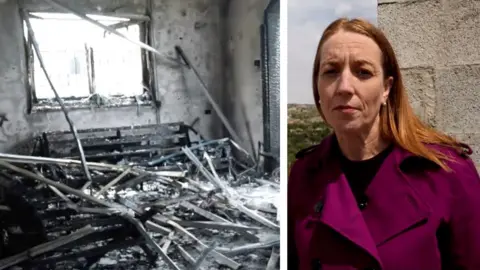
JERUSALEM — A wave of coordinated, extremist violence has swept through the occupied West Bank, as hundreds of masked settlers launched what local human rights groups are calling a "night of pogroms" against Palestinian civilians. Reporting for 24x7 Breaking News, we have tracked reports of multiple villages, including Jalud, Qaryut, and al-Funduqmiya, coming under direct assault as homes, vehicles, and agricultural fields were set ablaze under the cover of darkness. The surge in Israeli settler violence West Bank has reached a fever pitch, leaving at least three Palestinians hospitalized with severe head injuries and dozens of families displaced from their scorched residences.
- The Digital Architecture of a Revenge Campaign
- A Breakdown of Security and State Accountability
- The Humanitarian Toll on Palestinian Families
- Editorial Perspective: The Moral Decay of State-Sanctioned Silence
- Frequently Asked Questions (FAQ)
- What sparked the recent surge in settler violence?
- Which villages were most affected by the attacks?
- What has been the official government response?
- How many people have been injured or killed?
The violence appears to be a direct, vigilante response to the death of 18-year-old Yehuda Sherman, a settler who was killed on Saturday after his quad bike was struck by a vehicle driven by a Palestinian. While Israeli police are still investigating whether the collision was a deliberate act of terror or a tragic traffic accident, extremist elements within the settlement movement did not wait for a verdict. Extremist Jewish settlers quickly mobilized via encrypted WhatsApp groups, calling for an immediate "revenge campaign" to avenge Sherman’s blood, leading to more than 20 separate attacks overnight across the territory.
The Digital Architecture of a Revenge Campaign
We've examined the digital trail of this escalation, and the level of organization is chilling. In private messaging groups, settlers shared coordinates and instructions, with one post intercepted by Israeli media stating, "Jews won’t remain silent over spilled Jewish blood." Another message was even more explicit in its intent: "We demand vengeance and expulsion of the enemy." This wasn't a spontaneous outburst of grief; it was a coordinated paramilitary operation targeting civilians during the holy celebration of Eid al-Fitr.
Footage obtained by the BBC—and corroborated by local activists—shows a terrifying scene in the village of Jalud. More than 90 individuals, many dressed in black and wearing masks to evade identification, were seen sprinting into the village. Within minutes, the sound of sirens filled the air as ambulances struggled to reach the wounded. On the side of a Palestinian building, the words "Avenge Yehuda" were spray-painted in Hebrew, serving as a grim signature for the destruction left behind.
The Palestinian Red Crescent Society confirmed that their teams treated multiple victims for head wounds inflicted during these confrontations. This spike in localized terror comes at a time of extreme regional instability, as we previously noted in our coverage of Trump’s Iran Brinkmanship, which has further polarized the Middle East. According to United Nations data, since the onset of the conflict with Iran on March 1, at least six Palestinians have been killed by settlers, marking one of the deadliest periods for non-combatants in recent history.
A Breakdown of Security and State Accountability
The Israel Defense Forces (IDF) and border police units were eventually dispatched to several villages, but the response has been criticized as being too little, too late. While the IDF issued a statement acknowledging "acts of arson against structures and property," the Israeli civil rights group Yesh Din accused security forces of a catastrophic failure. "Despite prior knowledge of the planned attacks, forces once again failed to prepare accordingly," the group stated on X. "No preventive measures were put in place to stop the pogroms."
The political optics are equally troubling. On Sunday afternoon, more than 500 people attended the funeral of Yehuda Sherman. Among the mourners was Israel’s far-right Finance Minister Bezalel Smotrich, a figure who has already been sanctioned by the United Kingdom and other nations for his role in inciting violence against Palestinians. His presence at the funeral, followed by reports of settlers blocking main roads in protest, has signaled to many that the occupied territories are operating under a state of "total anarchy," as described by Yair Golan, leader of Israel’s center-left Democrats.
Golan was scathing in his assessment of the current administration. "Jewish terrorism is spreading, exploiting the war, with the backing of extremist ministers," he wrote. He argued that the government’s focus on the northern border and the ongoing missile exchanges with Iran has created a security vacuum that extremists are all too happy to fill. This internal rot, he suggests, is a failure of responsibility for Israel’s own national security.
The Humanitarian Toll on Palestinian Families
For the residents of al-Funduqmiya and Silat al-Dhah, the technicalities of security failures mean very little compared to the loss of their livelihoods. We spoke with families who watched their olive groves—the backbone of their economic survival—turn to ash in a matter of hours. This isn't just about property; it's about the systematic erasure of a people’s ability to exist on their land. The Palestinian Ministry of Foreign Affairs has condemned the assaults, noting that targeting vital roads and junctions during a religious holiday is a calculated move to maximize terrorizing and killing of civilians.
The Palestinian Red Crescent remains on high alert as unconfirmed reports suggest settler groups are once again gathering outside Nablus. Earlier this month, the EU and UK issued stern demands for Israel to halt this surge in violence, yet the numbers continue to climb. Since the beginning of the year, the UN reports that seven Palestinians have been killed by settlers, while 18 have been killed by Israeli forces. The overlap between military action and settler vigilantism has become increasingly blurred, creating a environment where accountability is virtually non-existent.
This situation mirrors the global concerns raised in the UN’s Global Red Alert, where systemic instability and the breakdown of international norms lead to humanitarian catastrophes. When the rule of law is selectively applied, the resulting vacuum is always filled by those with the loudest voices and the sharpest weapons.
Editorial Perspective: The Moral Decay of State-Sanctioned Silence
In our view at 24x7 Breaking News, what we are witnessing in the West Bank is not merely a cycle of violence; it is the visible decay of the moral authority of the Israeli state. When a government includes ministers who have been sanctioned by their own allies for inciting violence, it sends a clear message to the extremist settlers: you are protected. The failure of the IDF to prevent these "pogroms"—a word we do not use lightly—suggests either a lack of capability or, more dangerously, a lack of will.
We believe that the label of "Jewish terrorism" used by Yair Golan is a necessary, if painful, acknowledgment of the reality on the ground. For too long, the international community has separated the actions of these extremist groups from the state apparatus that funds their infrastructure and protects their outposts. If Israel wishes to remain a respected member of the democratic world, it must treat these arsonists and vigilantes with the same severity it applies to any other threat to public safety. The burning of a home during Eid is not an act of "defense"; it is a crime against humanity that demands immediate and transparent justice.
What concerns us most is the long-term impact on the possibility of peace. Every torched car and every spray-painted threat is a nail in the coffin of a two-state solution. We must ask ourselves: how can a shared future exist when one side is permitted to burn the other's present? The Israeli settler violence West Bank must be stopped, not just for the sake of Palestinians, but for the soul of Israel itself.
Frequently Asked Questions (FAQ)
What sparked the recent surge in settler violence?
- The current wave of violence was triggered by the death of 18-year-old Yehuda Sherman, a settler who died in a vehicle collision. Extremist groups claimed it was a deliberate attack and launched a "revenge campaign" across several Palestinian villages.
Which villages were most affected by the attacks?
- The most significant damage was reported in Jalud, Qaryut, al-Funduqmiya, and Silat al-Dhah. Residents reported masked individuals setting fire to homes, cars, and agricultural property.
What has been the official government response?
- While the IDF and border police arrested five individuals, critics and opposition leaders like Yair Golan have accused the government of encouraging "total anarchy." Far-right ministers like Bezalel Smotrich have been seen supporting the settler community during this period.
How many people have been injured or killed?
- Since March 1, the UN reports that six Palestinians have been killed by settlers. In the most recent overnight attacks, at least three Palestinians suffered serious head wounds and required hospitalization.
The situation in the West Bank remains a tinderbox, with Israeli settler violence West Bank continuing to escalate as regional tensions with Iran boil over. As the international community watches, the fundamental question remains: who will hold these vigilantes accountable when the state itself seems divided? Is the Israeli government actually capable of stopping settler violence, or has the movement become too powerful for the state to control?
This article was independently researched and written by Hussain for 24x7 Breaking News. We adhere to strict journalistic standards and editorial independence.
Comments
Post a Comment