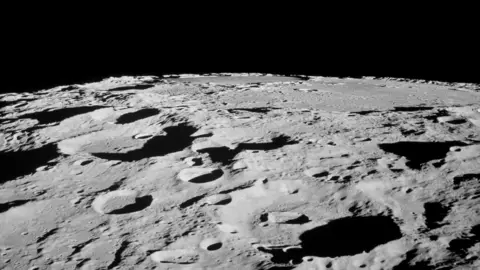
Reporting for 24x7 Breaking News. In a feat that echoes humanity’s first steps beyond Earth, NASA is on the cusp of launching the Artemis II mission, sending four astronauts on a historic trajectory around the Moon. This audacious voyage is not merely a symbolic return to a familiar celestial neighbor; it's a critical stepping stone, meticulously planned to pave the way for sustained lunar presence and, ultimately, a crewed mission to Mars. The Artemis program, a monumental undertaking that has consumed billions of dollars and the dedication of thousands, represents a profound investment in humanity's future in space.
- The Lunar Prize: More Than Just Dust and Rocks
- A New Geopolitical Arena: The Race for Lunar Real Estate
- Mars as the Ultimate Horizon: The Moon as a Crucial Proving Ground
- Unlocking Earth's Ancient Secrets: The Moon as a Cosmic Archive
- The Real-World Impact: Resource Security and the Future of Exploration
- A Humanitarian Perspective: A Shared Destiny Beyond Earth
- Frequently Asked Questions (FAQ)
- What is the primary goal of the Artemis II mission?
- Why is water on the Moon so important?
- What is the main competition in the new space race?
The Lunar Prize: More Than Just Dust and Rocks
While the allure of the Moon might seem like déjà vu after the triumphs of the Apollo era, the scientific and strategic imperatives have evolved dramatically. Beyond the prestige, the Moon is now understood to be a treasure trove of resources vital for future space exploration and potentially for Earth. Planetary scientist Professor Sara Russell of the Natural History Museum highlights the Moon's surprising abundance of elements critical for advanced technologies, including rare earth elements, iron, and titanium. These materials could fuel a burgeoning off-world economy, reducing the immense cost and logistical challenges of launching everything from Earth.
Perhaps the most significant discovery, however, is the presence of water ice, particularly in permanently shadowed craters near the lunar poles. As Russell explains, this ice is not just a source of drinking water for astronauts; it's a crucial component for life support, providing breathable air when split into oxygen and hydrogen, and even serving as propellant for spacecraft. Securing access to these lunar resources is becoming a paramount objective for space-faring nations, creating a new kind of territorial imperative.
A New Geopolitical Arena: The Race for Lunar Real Estate
The geopolitical landscape of space exploration has shifted dramatically since the Apollo missions. Where the United States once raced against the Soviet Union for ideological supremacy, today's primary competitor is China. Beijing has made remarkable strides in its space program, successfully landing robotic missions and setting an ambitious target of human lunar landings by 2030. This renewed competition underscores the strategic importance of lunar territory.
While the 1967 Outer Space Treaty prohibits national ownership of celestial bodies, the practical implications are far more nuanced. Dr. Helen Sharman, Britain's first astronaut, points out that while nations cannot claim sovereignty over lunar land, they can establish operational presences. "So the big thing right now is to try to grab your piece of land. You can't own it, but you can use it. And once you're there, you've got it for as long as you want it," Sharman stated, underscoring the intense drive to secure strategic locations rich in resources.
Mars as the Ultimate Horizon: The Moon as a Crucial Proving Ground
NASA's long-term vision firmly targets Mars for human exploration by the 2030s. However, the immense technological hurdles and inherent dangers of a Martian mission necessitate a rigorous preparatory phase. Libby Jackson, head of space at the Science Museum, emphasizes the Moon's role as an indispensable testbed. "Going to the Moon and staying there for a sustained period is much safer, much cheaper and much easier to be a test bed for learning how to live and work on another planet," Jackson explained.
A lunar base offers an unparalleled opportunity to refine critical technologies for survival on another world. This includes perfecting systems for generating breathable air and potable water, establishing reliable power sources, and constructing habitats that can shield astronauts from extreme temperatures and dangerous space radiation. The lessons learned and technologies validated on the Moon will be directly applicable to the far more challenging endeavor of reaching and living on Mars, mitigating the catastrophic risks of first-time failures in deep space.
Unlocking Earth's Ancient Secrets: The Moon as a Cosmic Archive
Beyond the immediate goals of resource utilization and Mars preparation, the Moon holds invaluable scientific secrets about our own planet. The lunar samples collected during the Apollo missions revolutionized our understanding of Earth's formation, providing evidence for the giant impact theory – that the Moon was formed from debris ejected when a Mars-sized protoplanet collided with early Earth. Professor Russell notes that these rocks are essentially a geological record, a time capsule preserving 4.5 billion years of Earth's history, untouched by the erosion and geological activity that has reshaped our home planet.
Access to new samples from different lunar regions could unlock further insights into Earth's deep past, offering a unique perspective on planetary evolution. This scientific quest, driven by an insatiable curiosity, adds another layer of significance to NASA's renewed lunar ambitions. The mission's success could not only redefine our presence in the solar system but also deepen our comprehension of our planet's origins and its place in the cosmos.
The Real-World Impact: Resource Security and the Future of Exploration
The implications of the Artemis program extend far beyond scientific curiosity and national prestige. The potential to access lunar resources like water ice and rare earth elements could fundamentally alter global supply chains and resource security in the long term. For everyday Americans, this might translate into eventually lower costs for advanced technologies and a more sustainable approach to resource management, both on Earth and in space. It also signifies a commitment to innovation and technological advancement that can spur economic growth and create high-skilled jobs. Furthermore, the development of technologies for space survival could yield unforeseen terrestrial applications, improving life on Earth.
A Humanitarian Perspective: A Shared Destiny Beyond Earth
As we look towards the stars, it's crucial to remember that space exploration, at its best, is a human endeavor that transcends borders and divisions. The Artemis program, while driven by national objectives, represents a collective leap for humankind. The challenges and discoveries that await us on the Moon and Mars are opportunities for global cooperation, fostering a sense of shared destiny and mutual understanding. The image of astronauts from diverse backgrounds working together on another world should inspire us to bridge divides here on Earth, recognizing that our common humanity is our greatest asset. This pursuit of knowledge and expansion is not about dominance, but about the enduring human spirit of exploration and our shared responsibility to protect and understand our place in the universe.
Frequently Asked Questions (FAQ)
What is the primary goal of the Artemis II mission?
The Artemis II mission is a crewed flight test that will send four astronauts on a trajectory around the Moon, serving as a critical precursor for future lunar landings and eventual human missions to Mars.
Why is water on the Moon so important?
Lunar water ice can be used for drinking, to create breathable air for astronauts, and as a source of rocket fuel, making it vital for establishing a sustainable human presence on the Moon and enabling deeper space exploration.
What is the main competition in the new space race?
The primary geopolitical competition in the current space race is between the United States and China, both of whom are actively pursuing lunar exploration and resource utilization goals.
The Artemis II mission is more than just a return to the Moon; it's a strategic pivot, a crucial testbed for ambitions that reach as far as Mars, and a potential key to unlocking vital extraterrestrial resources. The question now is whether this ambitious leap will foster global collaboration or intensify a new era of space-based competition.
So here's the real question — as nations vie for lunar resources and strategic positioning, can humanity truly unite for the sake of exploration, or will the 'final frontier' become another arena for terrestrial conflict?
This article was independently researched and written by Hussain for 24x7 Breaking News. We adhere to strict journalistic standards and editorial independence.
Comments
Post a Comment