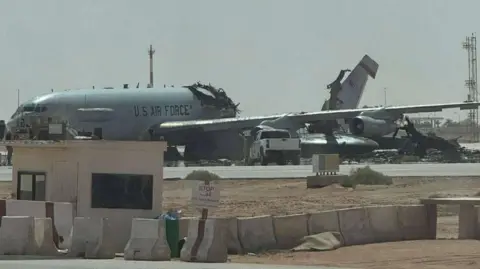
Reporting for 24x7 Breaking News. Verified images confirm the catastrophic destruction of a U.S. Air Force E-3 Sentry Airborne Warning and Control System (AWACS) aircraft at Prince Sultan Air Base, located approximately 100 kilometers southeast of Riyadh, Saudi Arabia. The aircraft appears to have been severely damaged, with photographs indicating it has been split into at least two sections.
- Understanding the E-3 Sentry's Critical Role
- Escalating Regional Tensions and Potential Attack Vectors
- The Human Cost of Geopolitical Conflict
- Our Take: A Stark Warning from the Sands of Arabia
- Frequently Asked Questions (FAQ)
- What is an E-3 Sentry AWACS aircraft?
- Where is Prince Sultan Air Base located?
- What are the potential implications of this incident?
The startling visual evidence, initially circulated on social media platforms carrying U.S. military news, has been corroborated by 24x7 Breaking News. Features within the images, including distinct pylons, storage units, and ground markings, have been cross-referenced with satellite imagery, confirming their location at the Saudi base. This incident occurs against a backdrop of heightened geopolitical stress in the region, with a U.S. official previously informing Reuters that 12 American personnel sustained injuries, two of them serious, during an alleged Iranian military action targeting the base.
Understanding the E-3 Sentry's Critical Role
The E-3 Sentry, based on a Boeing 707 airframe, is an indispensable asset for modern air operations. Its most distinctive feature, a large rotating radar disc atop its fuselage, enables unparalleled long-range detection and tracking capabilities. This sophisticated radar system is vital for providing early warning of potential threats and granting commanders crucial situational awareness to manage air battles effectively.
According to the U.S. Air Force, the E-3 AWACS provides essential information that allows commanders to gain and maintain control of the air environment. These aircraft, with the first entering service in 1977, were expected to remain operational for the USAF until at least 2035, underscoring their continued strategic importance. The loss of such a specialized and vital platform represents a significant blow to operational capacity.
Escalating Regional Tensions and Potential Attack Vectors
The destruction of the E-3 Sentry follows reports of an Iranian military engagement at the base. On Friday, a U.S. official speaking to Reuters detailed that 12 U.S. personnel were wounded, with two suffering serious injuries, in what was described as an Iranian military attack. The Wall Street Journal further reported that at least two U.S. refueling aircraft also sustained damage in the incident.
More recently, Iran's IRGC-linked Fars news agency claimed on Sunday that a Shahed drone was responsible for striking the E-3 aircraft. While 24x7 Breaking News has independently verified the presence of an E-3 aircraft at this location via satellite imagery from March 11th, we cannot definitively confirm if it is the exact same aircraft damaged in the recent event.
Further forensic analysis of the provided images revealed a visible tail number on the E-3. A check against flight-tracking data from Flightradar24 showed this particular aircraft was airborne near the base on March 18th. Additionally, satellite imagery captured on Friday appears to show a fire on the air base apron, approximately 1,600 meters east of where the damaged E-3 is located, though its connection to the aircraft's destruction remains unclear.
The Human Cost of Geopolitical Conflict
The implications of such an attack extend far beyond the material loss of an advanced aircraft. The wounding of 12 U.S. personnel, two critically, brings the human cost of escalating regional conflicts into sharp focus. These are individuals, families, and service members whose lives are directly impacted by the volatile geopolitical landscape. Their well-being and recovery are paramount, serving as a stark reminder of the personal sacrifices made in the name of national security and international stability.
The damage to refueling aircraft also hints at broader operational disruptions. Such an incident could impact the logistical capabilities and operational tempo of U.S. forces in the region, potentially affecting response times and the sustained presence required to manage ongoing security concerns. This is a reality that resonates even in contexts far removed, such as the challenges faced by teams like the Chicago Blackhawks, where even individual player performance has significant ripple effects across the entire organization, as we previously reported.
Our Take: A Stark Warning from the Sands of Arabia
In our assessment, the destruction of an E-3 Sentry AWACS aircraft at Prince Sultan Air Base is more than just a material loss; it's a potent signal of vulnerability and escalating aggression. The fact that such a critical, high-value asset could be compromised raises serious questions about the effectiveness of current defense postures and intelligence gathering in a region rife with asymmetric threats. The targeting of a platform that provides essential command and control capabilities suggests a deliberate strategic intent to degrade U.S. operational effectiveness.
We believe this incident demands a thorough and transparent investigation, not only into how the attack was executed but also into the broader implications for regional security architecture. The human toll, with injured service members, underscores the urgent need for de-escalation and diplomatic solutions. While the military must maintain readiness, as exemplified by the pursuit of fugitives and the constant need for strategic planning akin to what we've seen with trade buzz surrounding players like Myles Garrett, the ultimate goal must remain peace and the prevention of further loss of life and resources.
Frequently Asked Questions (FAQ)
What is an E-3 Sentry AWACS aircraft?
The E-3 Sentry is a military aircraft equipped with advanced radar and computer systems, providing airborne warning and control capabilities for tracking enemy aircraft and coordinating friendly forces.
Where is Prince Sultan Air Base located?
Prince Sultan Air Base is located in Saudi Arabia, approximately 100 kilometers (62 miles) southeast of the capital city, Riyadh.
What are the potential implications of this incident?
The destruction of the E-3 Sentry and the reported injuries to U.S. personnel signal an escalation of regional tensions and could impact U.S. operational capabilities and strategic posture in the Middle East.
The destruction of a vital E-3 Sentry AWACS aircraft in Saudi Arabia, coupled with reported casualties, serves as a grave reminder of the precarious security situation in the Middle East. This incident highlights the direct human cost of geopolitical conflict and the sophisticated nature of modern threats.
With such a critical command and control asset destroyed and personnel injured, what concrete steps must be taken to ensure the safety of U.S. forces and de-escalate tensions before a wider conflict erupts?
This article was independently researched and written by Hussain for 24x7 Breaking News. We adhere to strict journalistic standards and editorial independence.
Comments
Post a Comment