Unearthing a Legend: The Potential Discovery of D'Artagnan's Final Resting Place
Reporting for 24x7 Breaking News, we bring you a startling historical development out of the Netherlands: The remains of the legendary French musketeer, Charles de Batz de Castelmore, Count d'Artagnan, may have finally been located, resting silently beneath the floor of the St Peter and Paul Church in Maastricht.
- Unearthing a Legend: The Potential Discovery of D'Artagnan's Final Resting Place
- The Unlikely Catalyst: Broken Tiles Prompt a Deep Dive
- Forensic Clues Pointing to the Musketeer’s Identity
- The Waiting Game: DNA Analysis Underway in Germany
- Historical Context: The Fall of a Hero on Foreign Soil
- THE REAL-WORLD IMPACT: Connecting History to Present Day Security Concerns
- EDITORIAL PERSPECTIVE: Dignity Beyond the Dynasty
- FREQUENTLY ASKED QUESTIONS (FAQ)
- What was d'Artagnan’s historical significance?
- Why was d'Artagnan killed in the Netherlands?
- How certain are the discoverers that this is the correct skeleton?
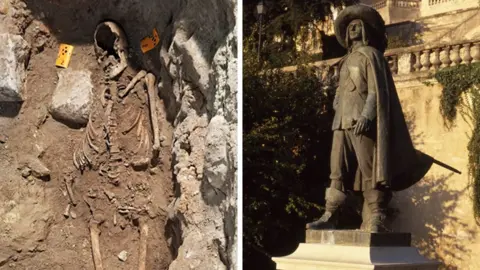
This potential find, unearthed during routine maintenance, sends ripples through historical circles, reviving the captivating saga of the Sun King’s loyal aide, killed over three centuries ago during the violent Siege of Maastricht in 1673. The discovery centers on a skeleton found precisely where the church altar stood centuries ago, a location suggesting high military honor.
The Unlikely Catalyst: Broken Tiles Prompt a Deep Dive
The impetus for this major excavation was surprisingly mundane: a few broken floor tiles near the former altar location. Jos Valke, the Deacon at St Peter and Paul Church, told the BBC that no one had previously dug beneath that section of the sanctuary.
What began as a simple repair evolved rapidly once workers uncovered a supporting wall and began carefully brushing away the earth. At this juncture, professional assistance was called in, bringing archaeologist Wim Dijkman onto the scene. Dijkman confirmed the recovery of a near-complete skeleton situated directly under the spot where the altar table had rested roughly 200 years prior.
Deacon Valke described the moment of discovery with palpable awe, noting that the team fell silent upon seeing the first bone emerge. He stated they were 99% certain the remains belonged to the famed right-hand man of Louis XIV, citing several strong indicators unearthed alongside the skeleton.
Forensic Clues Pointing to the Musketeer’s Identity
The evidence recovered has dramatically heightened expectations among historians. Valke pointed specifically to three compelling pieces of evidence found within the grave structure itself. First, they located the very projectile—a musket ball—believed to have ended d'Artagnan's life during the siege.
Second, they found a coin dating to around 1660, which Valke asserts was specifically minted for the Bishop who presided over Mass for the Roi Soleil (Sun King). Burial on sacred ground beneath the altar, coupled with these specific artifacts, strongly suggests a figure of immense military importance warranted such an intimate resting place.
However, the scientific community is understandably exercising caution. Archaeologist Wim Dijkman, who has reportedly been researching d'Artagnan’s potential grave for 28 years, stressed the need for absolute confirmation. He told the regional broadcaster Omroep Limburg, “I’m a scientist, but my expectations are high,” emphasizing the necessity of DNA analysis.
The Waiting Game: DNA Analysis Underway in Germany
To move this from compelling rumor to historical fact, samples have been carefully extracted from the remains. These critical biological samples are currently being analyzed in a laboratory in Germany to confirm identity, sex, and lineage. Further analysis is also taking place in Deventer to establish the precise age of the bones and their origin.
For Dijkman, this pursuit represents the potential apex of a decades-long academic quest. He characterized the potential identification as “the highlight of my career,” underscoring the deep personal investment involved in historical validation.
Historical Context: The Fall of a Hero on Foreign Soil
D'Artagnan met his end during the pivotal 1673 Siege of Maastricht, a key military objective for Louis XIV aimed at asserting French dominance in the region. Historical accounts suggest the famed captain was struck fatally in the throat by enemy fire during the intense fighting.
Because the battle occurred in mid-summer, the French forces, whose camp was located near the Wolder area—now the southwestern edge of modern Maastricht—opted for a local burial rather than transporting the body back to France. While the character immortalized by Alexandre Dumas in his adventure stories is a beloved fictional composite, the historical d'Artagnan was a very real, decorated officer.
THE REAL-WORLD IMPACT: Connecting History to Present Day Security Concerns
While the discovery of a 17th-century soldier’s remains might seem removed from modern policy debates, these moments of historical excavation often reveal deeper truths about how nations treat their fallen heroes and the lasting impact of conflict. In a world where international tensions flare constantly—from geopolitical disputes like those seen recently regarding West Bank settler violence to global supply chain issues stemming from conflict like the Iran War Fuel Crisis—revisiting the cost of military campaigns feels acutely relevant.
For the average citizen, this story is a powerful reminder of the human cost embedded within grand historical narratives. We celebrate the romanticized notion of the musketeer, but here lies the physical reality: a man shot down defending a political objective, buried hastily far from home. It underscores that behind every strategic move, whether in 1673 or today, there are individuals paying the ultimate price.
EDITORIAL PERSPECTIVE: Dignity Beyond the Dynasty
In our view, this discovery transcends mere historical curiosity; it is a profound exercise in restoring dignity to a figure whose death was swallowed by the machinery of an aggressive military campaign. It takes courage—both from the church officials who decided to look and the scientists who are now meticulously analyzing the evidence—to ensure that a person, regardless of their fame or proximity to royalty, receives proper recognition.
We often see nations grapple with historical wrongs, whether it involves reparations for past atrocities, such as the recent discussions spurred by Ghana Demands Slavery Reparations in Landmark UN Vote, or simply acknowledging the forgotten soldiers. Finding d'Artagnan offers a small, tangible victory for historical accuracy and respect. It is a quiet testament to the human desire to know the truth, no matter how long it takes for the physical evidence to surface. We must always advocate for the thorough and respectful examination of the past, ensuring that individual lives are not erased by sweeping historical narratives.
FREQUENTLY ASKED QUESTIONS (FAQ)
What was d'Artagnan’s historical significance?
- Charles de Batz de Castelmore, Count d'Artagnan, was a real historical figure who served as a highly trusted aide and Captain of the Musketeers for King Louis XIV of France.
Why was d'Artagnan killed in the Netherlands?
- He was killed during the 1673 Siege of Maastricht while fighting in the French army, an operation aimed at securing strategic territory for the expanding French kingdom under the Sun King.
How certain are the discoverers that this is the correct skeleton?
- Deacon Jos Valke expressed 99% certainty due to the burial location—under the altar—and the presence of a matching musket ball and a period-specific coin. However, official confirmation awaits DNA testing currently underway in Germany.
The potential recovery of d'Artagnan's remains offers a tangible connection to the high drama of 17th-century European warfare, moving the legendary figure from fiction back into verified history. The verification process will rely heavily on advanced forensic science to confirm the identity of this historical soldier buried in Maastricht.
If DNA confirmation proves this skeleton is indeed the legendary musketeer, should France formally request the repatriation of his remains, or does the discovery on Dutch soil create a shared historical legacy?This article was independently researched and written by Hussain for 24x7 Breaking News. We adhere to strict journalistic standards and editorial independence.
Comments
Post a Comment