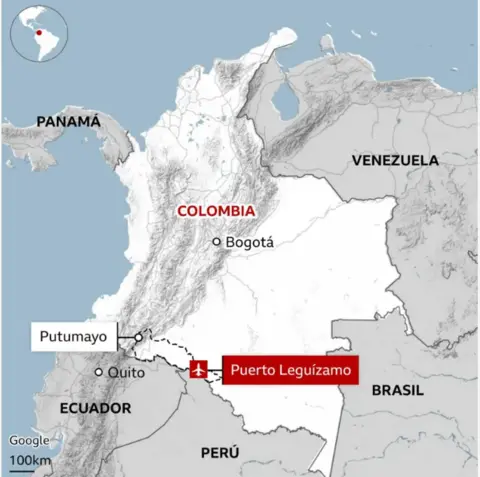
The silence of the southern Colombian jungle was shattered on Monday by a catastrophic failure that has now claimed the lives of 69 members of the national security forces. Reporting for 24x7 Breaking News, we have confirmed that the search and rescue operations for the survivors of the Colombian military plane crash have officially concluded, leaving a nation to grapple with the horrific aftermath of an aviation disaster that many saw coming. The tragedy, which occurred near the border with Peru, involved a Hercules C-130 transport aircraft that went down shortly after takeoff, carrying 126 souls into a nightmare of fire and twisted metal.
- The Heroism of Putumayo and the Chaos of the Crash
- 'Scrap Metal' and the Political Firestorm
- A Pattern of Failure in the Skies
- Our Editorial Perspective: The Human Cost of Negligence
- Frequently Asked Questions (FAQ)
- What caused the Colombian military plane crash?
- How many people were on board the Hercules C-130?
- Where exactly did the crash take place?
According to official statements from the Colombian armed forces on Wednesday, the death toll reached its grim finality after days of scouring the Putumayo region. Of the 126 people on board—a figure revised from an earlier estimate of 128—57 individuals were pulled from the wreckage with varying degrees of injury. The manifest included 113 army members, two police officers, and 11 crew members. This event marks one of the deadliest military aviation accidents in South American history, and as the smoke clears, the political fallout is only beginning to ignite.
The Heroism of Putumayo and the Chaos of the Crash
As we analyzed the initial reports, a harrowing picture emerged of the moments following the impact. The plane was traveling from Puerto Leguízamo to Puerto Asís when it lost altitude almost immediately after leaving the runway. Mobile phone footage, which we have verified through social media channels, shows a terrifying sequence: the massive four-engine turboprop struggling for height before vanishing behind a tree line, followed by a massive plume of black smoke and the rhythmic staccato of secondary explosions. Colombia’s defense minister later clarified that these sounds were not the result of an attack, but rather the ammunition stored on board detonating in the intense heat of the crash.
In the absence of immediate military rescue teams, it was the local farming community that stepped into the breach. Noé Mota, a local farmer who spoke with the AFP news agency, described a scene of pure adrenaline and horror. "I felt an explosion in the air and, when I looked up, the plane was flying close to the house on my plot," Mota recounted. Locals didn't wait for official orders; they rushed into the burning debris, pulling survivors from the fuselage and ferrying them to distant hospitals on the backs of their motorbikes. This level of grassroots heroism is a stark contrast to the institutional failures now being debated in the capital.
The scale of this tragedy is reminiscent of other international mass casualty events we've followed, such as the horror in Kericho where 32 bodies were found in a mass grave, highlighting how suddenly life can be extinguished in regions with limited infrastructure. In Putumayo, the lack of paved roads and rapid-response medical facilities meant that the difference between life and death for the 57 survivors often came down to the speed of a neighbor's motorcycle.
'Scrap Metal' and the Political Firestorm
While the military is focused on the recovery of remains, President Gustavo Petro has turned his attention to the systemic issues he believes caused the disaster. In a series of provocative social media posts, Petro did not mince words, essentially accusing the previous administration and bureaucratic inertia of sending young soldiers to their deaths in substandard equipment. Referring to the aircraft—though not by its formal name—Petro wrote, "This piece of scrap metal was bought in 2020 and came down, let's ask why."
Petro’s frustration stems from what he calls "bureaucratic problems" that have stalled his administration's efforts to modernize the Colombian Air Force. The President has been vocal about the need to move away from aging hardware, stating, "I will allow no further delays, the lives of our young people are at stake." This rhetoric has sent shockwaves through the military establishment, as the Hercules C-130 is generally considered a workhorse of global aviation. However, when these planes are not maintained or are purchased under questionable circumstances, they become flying coffins.
We've seen similar government tensions during infrastructure crises elsewhere, such as when Marcos declared an energy emergency amid an oil shock to bypass bureaucratic red tape. Petro seems to be attempting a similar maneuver, using this tragedy to force a total overhaul of military procurement. The question remains: was it a mechanical failure of "scrap metal," or a failure of the systems meant to keep those planes in the sky?
A Pattern of Failure in the Skies
What makes the Colombian military plane crash even more disturbing is that it is not an isolated incident for this specific aircraft model in the region. Just weeks ago, on February 27, a Hercules C-130 belonging to the Bolivian army crashed into a highway in El Alto after overshooting a runway. That incident killed 24 people. Two C-130 crashes in as many months raise serious questions about the regional maintenance standards for these aging American-made transports.
The Putumayo region, where this latest crash occurred, is a notoriously difficult environment for aviation. It is a hub for various armed groups, though the defense ministry has been quick to rule out foul play in this instance. The focus is squarely on aviation safety and the technical integrity of the 11 crew members' actions. Investigators are currently analyzing the flight data recorders to determine if the Putumayo region crash was caused by engine failure, weight imbalances, or pilot error in the thin, humid air of the southern panhandle.
Our Editorial Perspective: The Human Cost of Negligence
In our view, the deaths of 69 security force members are not just a statistics-driven tragedy; they are a profound indictment of how we value the lives of those who serve. It is easy for politicians to argue over budgets and "bureaucratic problems" in the air-conditioned halls of Bogotá, but the reality is felt in the mud and smoke of Putumayo. We believe that if a nation asks its young people to fly into remote, dangerous territories for the sake of national security, it owes them the highest standard of technology available.
What concerns us most is the cynical nature of military procurement. If President Petro is correct and this aircraft was indeed "scrap metal" when it was acquired in 2020, then this is not an accident—it is a crime of negligence. We must ask ourselves why developing nations are so often the dumping ground for aging Western hardware that is deemed too risky for original operators. There is a deep humanitarian crisis when the tools of peace and transport become weapons of self-destruction for the very people they are meant to carry.
We stand with the families of the fallen and the brave civilians of Putumayo who risked their lives to save others. True leadership requires more than just mourning; it requires a radical transparency in how these multi-million dollar contracts are signed and who, ultimately, pays the price when the engines fail. The military modernization of Colombia cannot wait for another 69 funerals to become a priority.
Frequently Asked Questions (FAQ)
What caused the Colombian military plane crash?
- While an official investigation is ongoing, President Gustavo Petro has suggested that the aircraft was "scrap metal" and suffered from mechanical failure due to its age and condition.
- The defense ministry has ruled out an attack by armed groups, noting that the explosions heard were from ammunition on board.
How many people were on board the Hercules C-130?
- There were a total of 126 people on board, including 113 army members, two police officers, and 11 crew members.
- 69 people were killed, and 57 were injured in the accident.
Where exactly did the crash take place?
- The plane went down in the Putumayo region of southern Colombia, near the town of Puerto Asís, shortly after taking off from Puerto Leguízamo.
The tragedy of the Colombian military plane crash serves as a grim reminder that the cost of government inefficiency is often paid in human lives. As the investigation continues, the world will be watching to see if President Petro's calls for reform lead to actual change or just more political posturing.
So here's the real question—if the President himself calls his military's equipment 'scrap metal,' why are soldiers still being ordered to fly in it?
This article was independently researched and written by Hussain for 24x7 Breaking News. We adhere to strict journalistic standards and editorial independence.
Comments
Post a Comment