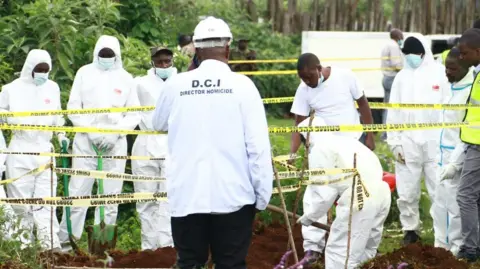
Reporting for 24x7 Breaking News — The red soil of western Kenya has yielded a secret so grim it has shaken the nation’s conscience to its core. In the quiet town of Kericho, forensic teams have completed a harrowing exhumation, unearthing 32 bodies from a Kenya mass grave discovery that appears to involve a staggering number of infants and fetuses. What began as a tip-off from a whistleblower has transformed into a high-stakes criminal investigation that exposes deep fractures in the country’s medical and judicial systems.
- The Grim Inventory of Gunny Bags and Rain-Sodden Earth
- A Systemic Failure of Medical Ethics and Public Trust
- The Real-World Impact: Why This Matters to You
- Our Perspective: The Devaluation of Life in the Pursuit of Convenience
- Frequently Asked Questions (FAQ)
- How many bodies were found in the Kericho mass grave?
- Who is responsible for the burials?
- Is this related to the Shakahola cult deaths?
- What happens next in the investigation?
We’ve been following the developments since Tuesday, when homicide detectives from the Directorate of Criminal Investigations (DCI) descended on a site owned by the National Council of Churches of Kenya (NCCK). Under a relentless downpour, investigators in white protective suits worked through the mud to retrieve remains that were, in the words of government pathologist Richard Njoroge, "stacked in gunny bags." The sheer lack of dignity in how these human beings were discarded has sparked a firestorm of local and international outrage.
The Grim Inventory of Gunny Bags and Rain-Sodden Earth
The scale of the Kenya mass grave discovery far exceeded initial police expectations. While a court order was originally obtained to retrieve 14 bodies, the final count stood at 32 by Tuesday evening. Dr. Richard Njoroge confirmed to journalists that the remains included seven adults and 25 children, many of whom were infants or fetuses. The condition of the remains tells a story of staggered deaths; while the adult remains were in advanced stages of decomposition, the children’s bodies were less so, suggesting they were buried at different intervals.
Our team looked into the preliminary findings, which suggest a disturbing link to institutional negligence. The DCI reported that at least 13 unclaimed bodies were officially released from a hospital in neighboring Nyamira County last Friday. However, the discovery of nearly 20 additional bodies—and the haphazard manner in which they were stuffed into sacks—raises urgent questions about whether this was a standard disposal gone wrong or something far more sinister. We cannot ignore the chilling parallels to other cases where the most vulnerable members of society are treated as disposable, much like the patterns of systemic neglect seen in the Meta child safety failures that recently led to a massive jury verdict in the United States.
The NCCK, whose land was used for the burial, has moved quickly to distance itself from the tragedy. An official for the organization told the Daily Nation that the burial was conducted without their knowledge or approval. This leaves a massive void in accountability: How did a truckload of bodies enter private land and get buried in mass pits without a single official sounding the alarm until a whistleblower stepped forward?
A Systemic Failure of Medical Ethics and Public Trust
As we analyzed the reports from the ground, the involvement of public health officials became the central pivot of the investigation. Two suspects—a public health officer from Nyamira and a cemetery caretaker—have already been arrested. The DCI is currently interrogating them to determine if this was a case of "irregularities in the burial process" or a criminal cover-up. The presence of mutilated and dismembered body parts among the remains has led human rights groups like Vocal Africa to describe the scene as a "horrific escalation" of violence.
Identification of the victims remains the most pressing humanitarian hurdle. Faith Odhiambo, the outgoing president of the Law Society of Kenya, has been vocal in demanding a transparent, national-level investigation. For the families in Nyamira and Kericho who may have lost infants in local hospitals, the fear that their children ended up in a gunny bag in a Kenya mass grave discovery is an unbearable psychological burden. This reminds us of the long-standing trauma faced by those seeking justice against powerful entities, similar to the Epstein survivors who had to fight for decades to be heard.
The forensic process is expected to be lengthy. Autopsies scheduled for Wednesday will attempt to determine the exact cause of death for each individual. Investigators are particularly interested in whether the infants were stillborn or if their deaths occurred under suspicious circumstances within the hospital system. In a country still reeling from the Shakahola forest cult deaths—where 429 followers of Paul Mackenzie were found in mass graves last year—the sight of detectives digging up earth is a recurring nightmare that Kenya is desperate to end.
The Real-World Impact: Why This Matters to You
While this horror is unfolding in Kericho, the implications ripple far beyond Kenya’s borders. For everyday people, this story is a terrifying reminder of what happens when public health oversight collapses. When the state fails to regulate how hospitals handle the deceased, it creates a vacuum where criminal shortcuts become the norm. For families living in poverty, the inability to afford a proper burial often leaves them at the mercy of state facilities. If those facilities view human remains as mere waste to be disposed of in sacks, the social contract is effectively dead.
This case also highlights the critical role of whistleblowers. Without one individual choosing to speak up, these 32 souls might have remained forgotten under the rain-slicked soil of Kericho indefinitely. It forces us to ask: How many other "secret" burial sites exist across the globe, hidden by bureaucracy and a lack of transparency? For the people of Kericho, the psychological impact is immediate; their community has become a crime scene, and their trust in local medical institutions has been vaporized.
Our Perspective: The Devaluation of Life in the Pursuit of Convenience
In our view, the Kenya mass grave discovery isn't just a story about a botched hospital burial; it’s a searing indictment of a global culture that increasingly treats the poor and the unborn as statistical inconveniences. What concerns us most is the clinical language often used by officials to describe these events—terms like "unclaimed bodies" and "disposal irregularities" mask the visceral reality of infants being stuffed into gunny bags like refuse.
We believe that the dignity of a society is measured by how it treats its most vulnerable members, both in life and in death. The fact that 25 of the 32 bodies were children and fetuses suggests a catastrophic failure in maternal and neonatal care, or worse, a systemic effort to hide mortality rates. Why were these bodies "unclaimed"? Was it because the parents couldn't be reached, or because they couldn't afford the "release fees" often extorted by corrupt hospital staff? We must demand more than just arrests; we need a complete overhaul of how forensic accountability is handled in East Africa. Anything less is an insult to the 32 victims currently lying in evidence bags in Kericho.
Frequently Asked Questions (FAQ)
How many bodies were found in the Kericho mass grave?
- A total of 32 bodies were recovered, consisting of 25 children (infants and fetuses) and 7 adults.
- Initial reports suggested only 14 bodies, but the scope expanded as forensic teams continued digging.
Who is responsible for the burials?
- The DCI has arrested a public health officer from Nyamira County and a cemetery caretaker.
- The land belongs to the NCCK, but they have denied any involvement or prior knowledge of the burial.
Is this related to the Shakahola cult deaths?
- Currently, there is no evidence linking this to Paul Mackenzie's cult; it appears to be related to hospital disposal irregularities.
- However, the discovery has reignited the national trauma associated with the 2023 Shakahola tragedy.
What happens next in the investigation?
- Autopsies began on Wednesday to determine the cause of death and identify the remains.
- Investigators are checking hospital records in Nyamira to see which bodies were officially released for burial.
The Kenya mass grave discovery in Kericho remains an active crime scene, and as the rain continues to fall on the site, the search for the truth is only beginning. The world is watching to see if Kenya will deliver justice for the 32 souls found in the dark.
So here's the real question — if a hospital can lose track of 32 bodies, including 25 infants, what else is being hidden behind the closed doors of our public institutions?
This article was independently researched and written by Hussain for 24x7 Breaking News. We adhere to strict journalistic standards and editorial independence.
Comments
Post a Comment