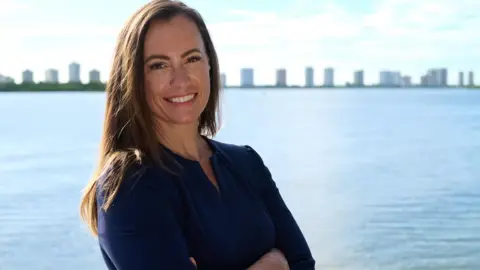
In a result that has sent shockwaves through the American political establishment, Democrats flip Florida seat District 87 in a stunning special election upset that took place right in the backyard of Donald Trump’s Mar-a-Lago estate. Reporting for 24x7 Breaking News, our team has confirmed that political newcomer Emily Gregory defeated the Trump-endorsed Republican candidate, Jon Maples, in a race that was widely seen as a litmus test for the former president's influence in the Sunshine State.
- The Calculus of a Political Upset in Palm Beach
- Trump’s Endorsement and the Byron Donalds Factor
- A Shift in the Florida Political Landscape
- THE REAL-WORLD IMPACT
- EDITORIAL PERSPECTIVE: THE CRACKS IN THE MAR-A-LAGO WALL
- A HUMANITARIAN PERSPECTIVE
- Frequently Asked Questions (FAQ)
- Who won the Florida District 87 special election?
- Did Donald Trump endorse a candidate in this race?
- What makes this election significant for the 2026 midterms?
- Does District 87 include Mar-a-Lago?
The victory represents a massive 19-point swing from the 2024 general election, where Republicans had previously held the seat with ease. As the final ballots were tallied late Tuesday night, the data revealed a significant shift in suburban and coastal voting patterns, suggesting that the once-impenetrable "Red Wall" of Florida may be developing structural cracks as we head deeper into Trump's second term.
The Calculus of a Political Upset in Palm Beach
Emily Gregory, a first-time candidate who many political analysts initially dismissed, characterized her victory as the result of a "crazy calculus" that prioritized local concerns over national culture wars. Speaking to MSNBC shortly after the race was called, Gregory noted that while the odds were stacked against her, the math for a flip was always present if the right issues were highlighted. "I might have done some crazy calculus to decide that this was a flip opportunity, but it was," Gregory told reporters. "And we did it. So my math worked."
The Florida District 87 special election was triggered by an unexpected vacancy, leaving an open seat in a district that encompasses some of the wealthiest and most politically significant real estate in the country. This includes the Mar-a-Lago club, the primary residence of Donald Trump, making the defeat of his hand-picked candidate, Jon Maples, particularly stinging for the MAGA movement. Maples had campaigned heavily on a platform of "continuing the Trump legacy," but it appears the local electorate had other priorities.
We've observed similar shifts in international contexts recently, where established parties have struggled to maintain their mandates. For instance, the ongoing Danish political stalemate showcases how kingmakers can emerge when traditional power centers fail to address the immediate needs of their constituents. In Palm Beach, the "kingmaker" role was played by independent and moderate voters who broke for Gregory in record numbers.
Trump’s Endorsement and the Byron Donalds Factor
The Republican loss occurred despite high-profile intervention from the top of the party. Donald Trump himself took to Truth Social to urge his followers to support Maples, calling him a "great patriot" and framing the special election as a necessary defense of his home turf. Furthermore, Republican Congressman Byron Donalds, who is currently seen as a frontrunner in the race for Florida Governor, filmed a personal endorsement video for Maples, signaling the high stakes the GOP placed on this single state House seat.
The failure of these endorsements to move the needle suggests a potential fatigue with top-down political directives. Our editorial team analyzed the voter turnout in Palm Beach and found that Democratic engagement was nearly 12% higher than in previous special cycles. This surge in grassroots energy is being hailed by DNC Chair Ken Martin as a blueprint for the 2026 midterms. "If Democrats can win in Trump’s backyard, we sure as hell can win anywhere across the country," Martin wrote on X.
This localized rejection of Trump-backed candidates comes at a time when global economic anxieties are peaking. As Larry Fink warns of $150 oil prices and the potential for a global recession, voters are increasingly looking for pragmatic leaders who focus on the cost of living rather than ideological battles. Gregory’s campaign focused heavily on insurance costs and environmental protection—issues that resonate deeply with Palm Beach residents regardless of their national party affiliation.
A Shift in the Florida Political Landscape
For years, Florida has been trending toward a solid red status, with Governor Ron DeSantis winning his last reelection by nearly 20 points. However, the special election results in District 87 suggest that the pendulum may be starting to swing back. Since the beginning of 2025, Democrats have successfully flipped several state House seats, often in districts that were previously considered safe Republican territory.
The strategic failure of the GOP in this race can be attributed to several factors. First, the reliance on national figures like Trump and Donalds may have backfired by nationalizing a race that voters wanted to keep local. Second, the Republican electoral vulnerability was exposed by a candidate like Gregory, who avoided inflammatory rhetoric and instead focused on the "math" of governance. We believe this represents a significant shift in how suburban voters view the current administration’s second-term agenda.
THE REAL-WORLD IMPACT
The victory of Emily Gregory means that residents of District 87 will now have a representative focused on tackling the property insurance crisis that has plagued South Florida. For the average family in Palm Beach, this isn't about partisan optics; it’s about the reality of monthly bills. A Democratic voice in the state legislature provides a check on the Republican supermajority, potentially forcing a more bipartisan approach to the state’s skyrocketing cost of living.
Furthermore, this flip signals to businesses and investors that Florida’s political climate is not a monolith. When Democrats flip Florida seat District 87, it tells the market that moderate, centrist policies still have a path to victory in one of the most economically influential counties in America. This could lead to a renewed focus on environmental legislation and infrastructure projects that were previously sidelined in favor of culture-war debates.
EDITORIAL PERSPECTIVE: THE CRACKS IN THE MAR-A-LAGO WALL
In our view, the result in District 87 is more than just a localized upset; it is a profound rejection of the idea that proximity to power equals popular support. For Donald Trump to lose a legislative seat that literally contains his own home is a symbolic blow that cannot be overstated. It suggests that even those who live in the shadow of Mar-a-Lago are looking for a different direction—one that emphasizes dignity, practical solutions, and a departure from the constant noise of national grievance politics.
We believe the American voter is becoming increasingly sophisticated in distinguishing between the spectacle of national politics and the necessity of local governance. Emily Gregory’s "math" worked because she treated voters like adults who care about their communities. The GOP’s mistake was assuming that a Truth Social post and a celebrity endorsement would be enough to bypass the hard work of addressing the kitchen-table issues that actually keep people up at night.
As we look toward the 2026 midterms, this race should serve as a wake-up call. The "Trump effect" is showing signs of diminishing returns, especially in high-information districts where the contrast between rhetoric and reality is most visible. We must advocate for a political system that prioritizes human dignity and mutual understanding over the performative loyalty tests that defined the Maples campaign. The people of District 87 have spoken, and they chose a future defined by results, not just rallies.
A HUMANITARIAN PERSPECTIVE
At its core, every election is a reflection of the human desire for a better, more stable life. When we look past the charts and the "crazy calculus," we see thousands of individuals who simply want their voices heard. There is a deep, inherent dignity in the act of a community coming together to choose its path, especially when that path involves a peaceful transition of political power in a highly contested area.
We advocate for a world where political leaders are judged by their empathy and their ability to bring people together, rather than their ability to divide. The victory in Palm Beach is a testament to the fact that even in our most polarized moments, there is a shared humanity that can be reached through honest dialogue. Let us hope that this shift leads to more compassionate policy-making that protects the vulnerable and ensures a sustainable future for all Floridians.
Frequently Asked Questions (FAQ)
Who won the Florida District 87 special election?
- Democrat Emily Gregory, a first-time candidate, defeated Republican Jon Maples.
Did Donald Trump endorse a candidate in this race?
- Yes, Donald Trump personally endorsed Republican Jon Maples on Truth Social, but Maples ultimately lost the seat.
What makes this election significant for the 2026 midterms?
- The 19-point swing from Republican to Democratic control suggests a shift in voter sentiment and provides Democrats with significant momentum heading into the national midterm cycle.
Does District 87 include Mar-a-Lago?
- Yes, the legislative district includes the Palm Beach area where Donald Trump's Mar-a-Lago club and residence are located.
The political map of the Sunshine State is being redrawn, one special election at a time, proving that no district is truly safe when the message of change resonates with the people. As Democrats flip Florida seat District 87, the question remains whether this is a localized anomaly or the start of a national trend. So here's the real question—is the MAGA brand finally losing its luster in the very places it once called home?
This article was independently researched and written by Hussain for 24x7 Breaking News. We adhere to strict journalistic standards and editorial independence.
Comments
Post a Comment