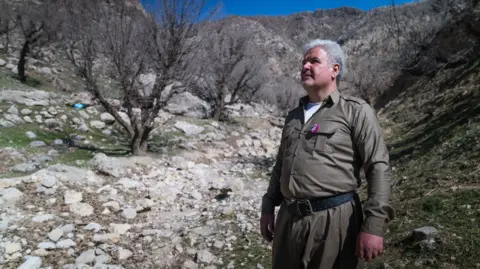
Reporting for 24x7 Breaking News, Northern Iraq – Amidst the stark, windswept mountains of northern Iraq, a quiet but determined resolve is hardening among exiled Iranian Kurds. For them, the call of home is inextricably linked to the memory of the living and the dead, a constant echo of loss and a fierce yearning for justice against the backdrop of a regime that has systematically suppressed them for decades. Many, like Shaho Bloori, 53, are preparing for a potential return to Iran, not for revenge, but for the fundamental promise of freedom.
- Echoes of Sacrifice, Demands for Freedom
- A New Front in the Mountains: Ready to Return
- The Perilous Journey and the Threat of Drones
- A Call for Ground Intervention and Uncertain Alliances
- The Human Cost of Conflict
- Frequently Asked Questions (FAQ)
- Who are the Iranian Kurds?
- What is the Peshmerga?
- What is Komala of the Toilers of Kurdistan?
- Why are they preparing to fight Iran from Iraq?
Echoes of Sacrifice, Demands for Freedom
Bloori, a veteran trainer for the Peshmerga – a term meaning "those who face death" – embodies this sentiment. He carries the weight of personal tragedy, having lost two sisters in Iran and eighteen relatives, including a brother executed at the tender age of 21. His brother, a protest singer, was not merely hanged but subjected to further indignities, his body riddled with bullets. Bloori recounted the harrowing tale his mother was forced to endure: washing her son's bullet-pierced body under the watchful, cruel eyes of the Islamic Revolution Guard Corps, forbidden to mourn lest she be denied the right to bury him.
"They told her: 'You must not cry. If you do, we will not let you clean him and bury him,'" Bloori shared, his voice tinged with a grief that time has not dulled. His vision for the future is not retribution, but a profound societal transformation. "We must stop the hanging," he stated, his gaze fixed on the distant horizon. "Even if someone is guilty of hanging my brother, I don't want them to be executed. We need freedom, not another regime like the Islamic regime."
Should Iranian Kurdish fighters based in Iraq decide to open a new front against the Islamic Republic by crossing into western Iran, Bloori's first act would be one of remembrance. He plans to visit the graves of his parents and brother, and all the friends and family lost to the regime. "I will lay flowers and tell them: 'I remember you always, and I cry for you,'" he vowed, momentarily silenced by the depth of his memories.
A New Front in the Mountains: Ready to Return
Bloori is currently based in a tented camp in northern Iraq, a temporary home for a burgeoning generation of Iranian Kurdish fighters. These individuals are part of a growing alliance of Iranian Kurdish organizations, recently formed with the explicit aim of opposing the current regime. Commander Bloori, a softly spoken, white-haired figure leading a dissident group known as Komala of the Toilers of Kurdistan, indicated that thousands of fighters are strategically positioned in the mountains, poised and ready to return home.
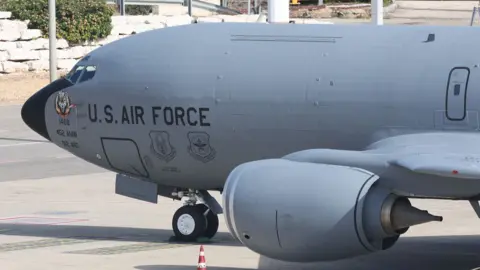
"That will be soon," he stated with quiet confidence. This movement emerges against a complex geopolitical backdrop. While groups like the Islamic Republic of Iran, the subject of intense international scrutiny, have seen previous confrontations, the potential for a ground offensive from Kurdish forces represents a significant escalation. The United States, under administrations like that of President Donald Trump, has historically oscillated in its support for such actions, often balancing strategic interests with domestic political considerations and global stability concerns. The ongoing tensions in the region, previously highlighted by U.S. military deployments, underscore the volatile nature of Middle Eastern politics and the potential for wider conflict. For more on the U.S. posture in the region, see our report on US Ramps Up Middle East Military Presence Amid Escalating Iran Tensions.
The Perilous Journey and the Threat of Drones
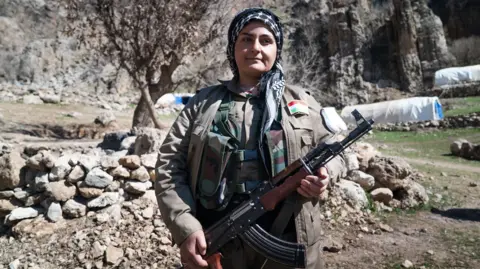
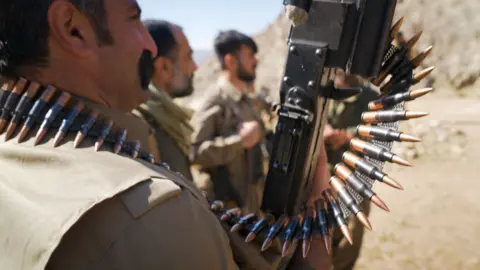
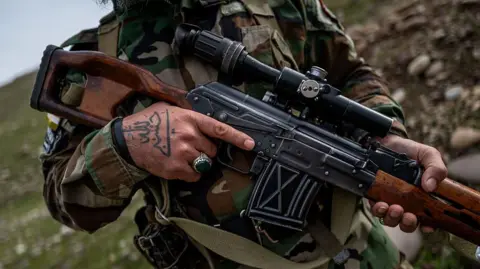
The journey to this remote camp, situated amidst breathtaking but exposed mountain peaks, is arduous. On our second attempt, after initial difficulties in reaching the location, we ascended a stony hillside. The thin air, compounded by the weight of body armor, made breathing a challenge. Upon arrival, we were met by approximately two dozen Peshmerga, men and women who greeted us with chants and raised Kalashnikovs, their voices echoing the defiant slogan, "Woman, life, freedom" – a cry that has resonated from Kurdish history to contemporary protests across Iran.
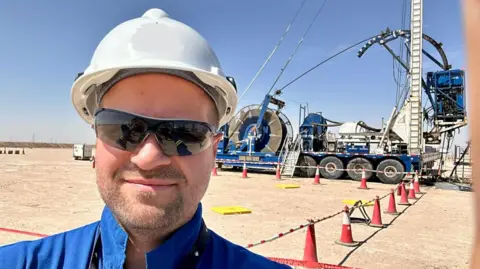
The camp itself is a collection of tents, a vulnerable outpost directly in the line of sight of Tehran. The proximity to Iran means constant vigilance. Just days before our visit, two drone strikes occurred approximately a kilometer away, causing injuries but fortunately no fatalities. This ever-present threat necessitates sophisticated security measures. Our team, accustomed to operating in war zones like Ukraine, carried drone detection equipment, providing an early warning system. Our safety advisor's stark instruction – "if there's nowhere to shelter, get down on your belt buckle" – underscored the reality of the danger.
A Call for Ground Intervention and Uncertain Alliances
Among the fighters was Amjad Hossein Panahi, a senior official from the Komala party and a Peshmerga himself, accompanied by his wife. Panahi has been a lifelong dissident, anticipating the fall of the Islamic regime since its inception 47 years ago. He believes that air strikes alone are insufficient to dismantle the government.
"Bombing is weakening the regime, but it's a big country and this is not enough," Panahi explained. "Ground forces must intervene, and the Kurds can play an important role in this." His immediate plea is for the United States to impose a no-fly zone. However, the pragmatism of international politics, particularly with fluctuating global oil prices impacting economies worldwide, raises questions about sustained U.S. engagement.
"I don't trust Trump," Panahi stated bluntly. "I feel he may decide to stop the war. This is my personal view. But whether or not Trump stops the war, the Islamic Republic..." His sentence trailed off, reflecting a common sentiment of uncertainty regarding external support. This reliance on foreign powers, while understandable given the circumstances, is a precarious position for stateless peoples striving for self-determination. It echoes the complex history of Kurdish aspirations, often caught in the geopolitical crosscurrents of the Middle East, a region frequently discussed in terms of shifting alliances and security concerns, such as those explored in analyses of Netanyahu's Iran Gambit: Regime Change Fades, But Is Israel's Security Truly Transformed?.
The Human Cost of Conflict
The prospect of renewed conflict weighs heavily on the minds of these exiles. Many have lived for years, even decades, in makeshift camps, their lives defined by displacement and the perpetual hope of return. The sacrifices made by their families and communities are not abstract political points; they are deeply personal wounds that fuel their determination. The fight for self-determination and basic human rights is a protracted one, marked by resilience in the face of overwhelming odds, a struggle that often goes unnoticed by the wider world until it erupts into broader regional instability.
For ordinary Americans, the unfolding events in this distant region serve as a stark reminder of the interconnectedness of global security and the enduring human cost of authoritarianism. While the immediate impact might seem distant, the potential for increased regional instability, refugee flows, and shifts in global energy markets can eventually touch the lives of people far from the front lines. The fight for freedom in Iran is not just a regional issue; it is a testament to the universal desire for dignity and self-governance, a principle that resonates deeply across cultures and borders.
Frequently Asked Questions (FAQ)
Who are the Iranian Kurds?
Iranian Kurds are an ethnic group indigenous to the mountainous border regions of Iran, Iraq, Turkey, and Syria. They have distinct linguistic, cultural, and historical identities, and have long sought greater autonomy or independence from the states they inhabit.
What is the Peshmerga?
The Peshmerga are the armed forces of the Kurdistan Region of Iraq. However, the term is also used more broadly by Kurdish fighters in Iran and Syria, signifying a commitment to defending Kurdish people and territories. It translates to "those who face death."
What is Komala of the Toilers of Kurdistan?
Komala is one of several Kurdish political and militant organizations operating primarily in Iran, advocating for the rights of Kurds within Iran, often through armed struggle. It is part of a broader coalition of Iranian Kurdish groups opposing the current Iranian regime.
Why are they preparing to fight Iran from Iraq?
Exiled Iranian Kurdish groups based in Iraq are preparing to potentially open a new front against the Iranian regime. This strategy aims to divert Iranian military resources and pressure the government from within its western borders, where a significant Kurdish population resides.
The resolve of these exiled Kurds, fueled by generations of suffering and a profound desire for freedom, highlights the complex and volatile geopolitical landscape of the Middle East. Their readiness to confront the Iranian regime from the rugged terrain of northern Iraq underscores a deep-seated struggle for self-determination.
So here's the real question – in a world often focused on state-level diplomacy and military might, can the persistent, deeply personal fight for freedom waged by stateless peoples like the Iranian Kurds truly alter the course of a powerful regime, or will their sacrifices remain unheard echoes in the mountains?

This article was independently researched and written by Hussain for 24x7 Breaking News. We adhere to strict journalistic standards and editorial independence.
Comments
Post a Comment