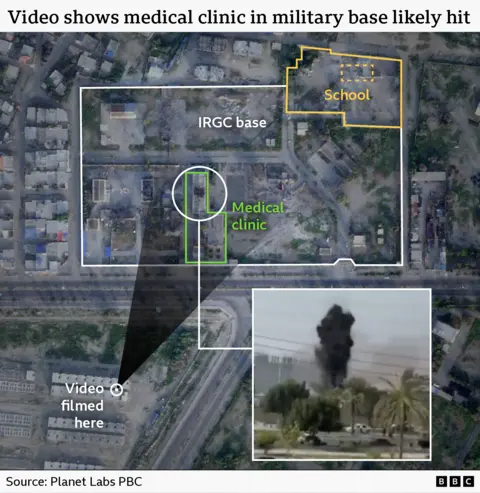
Reporting for 24x7 Breaking News, an independent video analysis indicates that a U.S. Tomahawk missile likely struck an Iranian Revolutionary Guard Corps (IRGC) military base adjacent to a primary school in Minab, southern Iran, where authorities reported over 160 fatalities, including approximately 110 children. The findings, bolstered by independent expert assessments, cast significant doubt on Iranian claims that a domestic missile caused the devastating blast.
- Expert Analysis Points to U.S. Munition
- Conflicting Narratives Emerge Amidst War
- The Tomahawk Missile and Its Implications
- The Human Cost and Information Blackout
- Frequently Asked Questions (FAQ)
- What evidence points to a U.S. missile strike?
- Why is an Iranian missile strike considered improbable?
- What is the U.S. official stance on the incident?
Expert Analysis Points to U.S. Munition
Verified footage, initially published by Iran's semi-official Mehr news agency, captures a missile moments before it impacted the IRGC base. BBC Verify has corroborated the authenticity of this video. Independent defense analysts, after meticulously examining the footage, have identified the munition as a U.S. Tomahawk cruise missile, a weapon system not known to be possessed by either Iran or Israel.
This latest analysis builds upon previous findings by BBC Verify, which used satellite imagery and verified videos to establish that the area near the school was subjected to multiple strikes. The presence of a Tomahawk, coupled with evidence of a coordinated, multi-strike operation, strongly suggests a U.S. military action, according to experts consulted by BBC Verify. The complexity and scale of the damage make a single Iranian missile strike highly improbable as the sole cause of the reported casualties.
Conflicting Narratives Emerge Amidst War
The incident has become a point of contention amidst escalating geopolitical tensions. On Saturday, U.S. President Donald Trump pointed blame towards Iran, stating, "We think it was done by Iran because they're very inaccurate, as you know, with their munitions. They have no accuracy whatsoever." This assertion contrasts with preliminary assessments from the U.S., shared with CBS News, suggesting the attack was "likely" the responsibility of U.S. forces but possibly an unintentional error, not a deliberate targeting of the school.
Adding to the complexity, an Israeli government source informed CBS News that Israel was not involved and its military had not been operating near the school. Iran, however, has publicly accused both the United States and Israel of orchestrating the attack. Neither Washington nor Tel Aviv has publicly claimed responsibility or explicitly denied involvement in the strike.
The Tomahawk Missile and Its Implications
The specific identification of the munition as a Tomahawk is critical. A senior analyst at McKenzie Intelligence Services stated the missile displayed "all the hallmarks of a U.S. Tomahawk in its terminal phase." The Tomahawk is a long-range cruise missile that has been a staple of the U.S. arsenal for decades, deployable from submarines, ships, and aircraft.
Wes Bryant, a national security analyst and former U.S. Air Force officer, also confirmed the munition's identity. Bryant further commented that the evidence pointing to multiple, deliberate strikes across the IRGC compound "is indicative of a deliberate and precise" U.S. operation. Conversely, N R Jenzen Jones, director of Armament Research Services, previously told BBC Verify that Iranian missiles typically carry "relatively small explosive warheads," making them unlikely to have caused the extensive blast damage observed.
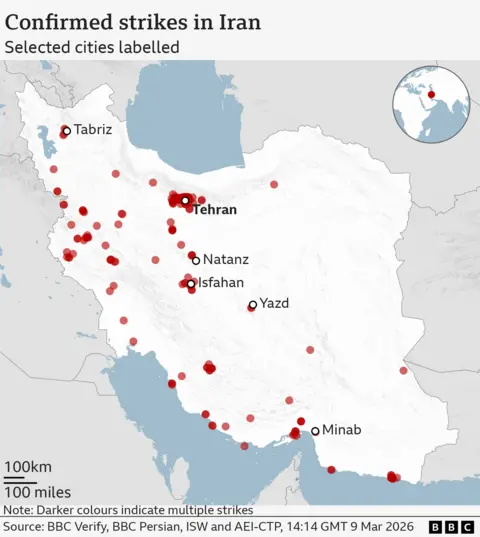
The U.S. military has acknowledged using Tomahawk missiles in operations against Iran. General Dan Caine, the U.S. military's most senior officer, stated on March 2nd that Tomahawks were among the first missiles fired by the U.S. Navy during "strikes across the southern flank." A subsequent Department of Defense press conference on March 4th presented an illustrative map showing U.S. strikes in the Minab area during the initial 100 hours of conflict, further corroborating the region's involvement.
The Human Cost and Information Blackout
The ongoing internet blackout within Iran has severely hampered independent verification of details surrounding the incident. Restrictions on international journalists operating within the country also make it exceptionally difficult to ascertain the precise sequence of events that unfolded in Minab on February 28th. The human toll, particularly the tragic loss of so many young lives, underscores the devastating consequences of conflict and the urgent need for clarity and accountability.
This incident echoes the profound grief and shock experienced in other devastating events, such as the violent shooting at Pop Superstar Rihanna's home, which tragically resulted in loss of life and highlighted the pervasive reach of violence. The complexities of international conflict and the opaque nature of warfare often leave families grappling with unanswered questions and profound sorrow.
Frequently Asked Questions (FAQ)
What evidence points to a U.S. missile strike?
Expert analysis of verified video footage identifies the munition as a U.S. Tomahawk cruise missile. Additionally, evidence of multiple, precise strikes on the military base suggests a coordinated operation consistent with U.S. military capabilities.
Why is an Iranian missile strike considered improbable?
Analysts suggest Iranian missiles typically carry smaller warheads, which would be unlikely to cause the extensive damage observed. The scenario of a single Iranian missile causing such a high death toll, especially near a school, is deemed highly improbable by experts.
What is the U.S. official stance on the incident?
President Trump has blamed Iran for the strike. However, preliminary U.S. assessments suggest the attack was likely carried out by U.S. forces but may have been an unintentional error rather than a deliberate targeting of the school.
The tragic events in Minab serve as a stark reminder of the devastating impact of armed conflict on innocent lives, particularly children. As the world grapples with conflicting narratives and limited access to information, the fundamental question of truth and accountability in wartime remains paramount. In an era of escalating global tensions, how can we ensure transparency and prevent the tragic loss of civilian lives during military operations?
This article was independently researched and written by Hussain for 24x7 Breaking News. We adhere to strict journalistic standards and editorial independence.
Comments
Post a Comment