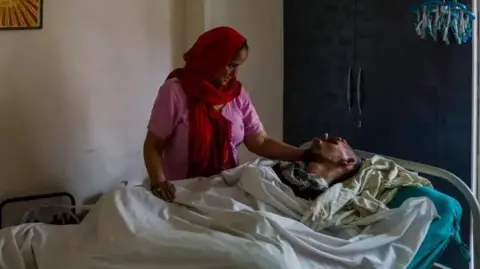
Reporting for 24x7 Breaking News, India's Supreme Court has delivered a landmark ruling, permitting the withdrawal of life support for 31-year-old Harish Rana, who has been in a vegetative state for over a decade. This decision marks the first instance of court-sanctioned passive euthanasia in India, a deeply personal and ethically complex issue that has long been debated across the nation.
- A Decade Lost, A Family's Plea
- Navigating the Legal and Ethical Landscape of Passive Euthanasia
- A Long Road Through the Courts
- The Human Reality of End-of-Life Decisions
- Frequently Asked Questions (FAQ)
- What is passive euthanasia?
- What is a living will?
- What is the legal status of euthanasia in India?
- What was the specific challenge in Harish Rana's case?
A Decade Lost, A Family's Plea
The tragic accident that led to Rana's condition occurred in 2013 when he suffered severe head injuries after falling from a fourth-floor balcony. Since then, he has remained in a comatose state, dependent on artificial means for survival. His parents, Ashok and his wife, have been his primary caregivers, exhausting their savings and facing the profound emotional and financial burden of his prolonged illness.
Their repeated pleas to the courts highlight a desperate situation. They expressed deep concern about what would happen to their son after their passing, a fear shared by many families in similar circumstances. In a statement released after the Supreme Court's decision, Ashok Rana conveyed his family's gratitude for what he termed a "humanitarian" judgment, acknowledging the difficulty of the decision but affirming it was made in Harish's best interest.
Navigating the Legal and Ethical Landscape of Passive Euthanasia
India legalized passive euthanasia in 2018, a legal framework that permits the withdrawal or withholding of life-sustaining treatment. Active euthanasia, however, remains illegal. The crucial distinction lies in the intent and action taken to end a life. Passive euthanasia, in this context, focuses on allowing a natural death by ceasing interventions.
Rana's case presented a unique challenge because he did not leave a living will or any explicit directives regarding his end-of-life care. This absence of a pre-stated wish meant his family had to petition the courts, initiating a lengthy legal process. The concept of a living will, a cornerstone of self-determination in end-of-life care, was central to the ethical discussions surrounding this case. A living will allows individuals to outline their medical preferences should they become incapacitated.
The Supreme Court, in its ruling on Wednesday, acknowledged that Rana has shown no meaningful response to treatment. The judges noted, according to legal news website Bar and Bench, that while he experiences sleep-wake cycles, he exhibits no interaction and requires complete assistance for all his needs. This medical assessment was critical in the court's deliberation.
A Long Road Through the Courts
Rana, then an engineering student at Punjab University, has been breathing with the assistance of a tracheostomy tube and receiving nutrition through a gastrostomy tube. His parents have reported that he cannot speak, see, hear, or recognize anyone, painting a stark picture of his condition.
The family's legal journey began with a rejected plea at the Delhi High Court in 2024. The court had initially ruled against their request, stating Rana was not on life-support machines and could sustain himself without external aid. This decision was later appealed as his condition deteriorated.
In a subsequent approach to the Supreme Court in 2025, the family argued that Rana was being kept alive artificially through life support. This time, the court agreed to hear the case after two independent medical boards assessed his condition. Both boards concluded that Rana had a negligible chance of recovery and required continuous external support for essential bodily functions, noting permanent brain damage and severe bedsores.
Under India's law governing living wills, a patient's life support can only be withdrawn after certification by two medical boards. Wednesday's order empowers these medical boards to exercise their clinical judgment regarding the withdrawal of treatment for Harish Rana. This decision may offer a path toward peace for a family that has endured immense suffering.
The Human Reality of End-of-Life Decisions
For families grappling with the prolonged suffering of a loved one in a vegetative state, the legal and emotional challenges are immense. The Rana case underscores the difficult questions that arise when medical technology can sustain life indefinitely, often at great personal and financial cost to families. The decision to withdraw life support, even when medically advised, is never easy and carries profound emotional weight.
This situation resonates with families across the globe who face similar dilemmas, forcing them to confront the limits of medical intervention and the definition of a life worth living. The absence of a living will, as in Rana's case, places an extraordinary burden on loved ones and the judicial system to make decisions that profoundly impact an individual's final moments.
The legal precedent set by this ruling could influence future cases in India, potentially providing a clearer pathway for families seeking to end the suffering of loved ones in irreversible vegetative states. It highlights the tension between the sanctity of life and the right to a dignified end, a debate that continues to evolve in many societies.
Frequently Asked Questions (FAQ)
What is passive euthanasia?
Passive euthanasia involves the withdrawal or withholding of life-sustaining treatments, allowing a patient to die naturally. It is distinct from active euthanasia, which involves a direct action to end a person's life.
What is a living will?
A living will is a legal document where an individual specifies their medical treatment preferences in the event they become unable to communicate their wishes due to illness or incapacitation. It is a key tool for asserting self-determination in end-of-life care.
What is the legal status of euthanasia in India?
India legalized passive euthanasia in 2018 through a Supreme Court ruling, provided certain conditions and medical certifications are met. Active euthanasia remains illegal.
What was the specific challenge in Harish Rana's case?
The primary challenge was that Harish Rana had not left a living will, meaning there were no explicit prior directives from him regarding his end-of-life care. This necessitated court intervention for the decision to withdraw life support.
India's Supreme Court has opened a new chapter in end-of-life care with its ruling on passive euthanasia, offering a potential resolution for families facing unimaginable burdens. The decision grapples with profound ethical questions about autonomy, dignity, and the limits of medical intervention.
So here's the real question — in the absence of a living will, how should society balance the state's interest in preserving life with an individual's right to die with dignity, especially when faced with irreversible medical conditions?

This article was independently researched and written by Hussain for 24x7 Breaking News. We adhere to strict journalistic standards and editorial independence.
Comments
Post a Comment