
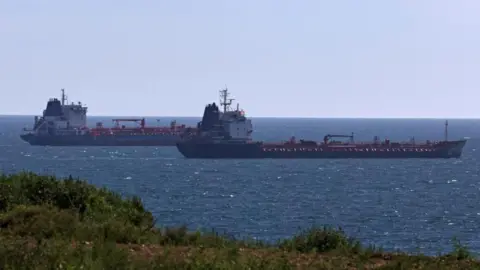
Reporting for 24x7 Breaking News. In a move that has sent shockwaves through allied capitals, the United States has temporarily suspended certain sanctions on Russian oil, a decision that European leaders and Ukrainian officials fear will embolden the Kremlin and prolong the devastating war in Ukraine. The announcement, made late Thursday by U.S. Treasury Secretary Scott Bessent, applies to Russian oil already on tankers at sea. This unilateral action has been met with sharp criticism, with French President Emmanuel Macron stating there is "no justification" for it, and German Chancellor Friedrich Merz deeming the decision "wrong." European Council President Antonio Costa echoed these sentiments, calling the development "very concerning."
- Kremlin's War Chest Swells Amid Global Instability
- Zelensky: Sanctions Relief Undermines Peace Efforts
- A Delicate Balance: Ukraine's Struggles and Russia's Respite
- Allies Urge Unified Pressure on Moscow
- Frequently Asked Questions (FAQ)
- What is the U.S. decision regarding Russian oil sanctions?
- Why are European leaders concerned about this decision?
- How does the conflict in the Middle East affect the situation?
- What is Ukraine's stance on the U.S. decision?
Kremlin's War Chest Swells Amid Global Instability
The timing of the U.S. move is particularly galling for Ukraine and its allies. Russia, already benefiting from rising oil prices exacerbated by the ongoing conflict in the Middle East, is now poised to receive a significant financial boost. European leaders worry that allowing more Russian oil onto the market will replenish the Kremlin's coffers, providing crucial funds for its war machine. Russia has been under extensive U.S. and European sanctions since its full-scale invasion of Ukraine began in February 2022.
This strategic easing of pressure comes as global energy markets are already rattled by the war involving Iran and its allies in the Gulf. While former President Donald Trump had previously imposed sanctions on major consumers of Russian oil and gas like India, the current administration's decision to offer a reprieve, even temporarily, signals a significant shift in diplomatic strategy.
Zelensky: Sanctions Relief Undermines Peace Efforts
Ukrainian President Volodymyr Zelensky minced no words in his assessment of the U.S. decision. Speaking at a news conference in Paris alongside his French counterpart, Zelensky stated that this single U.S. action is worth an estimated $10 billion to Russia. "This certainly does not help peace," he declared, emphasizing that increased revenues allow Russia to ease pressure on its war economy. The Kremlin has recently resorted to selling gold reserves and increasing consumption taxes to shore up its public finances, highlighting the strain of the ongoing conflict.
With additional oil revenues, Russia will be better positioned to purchase more weaponry and replenish its troop numbers on the front lines. This economic injection comes at a critical juncture for Ukraine, which has endured a brutal winter and recently begun to reclaim some territory. Kyiv has also demonstrated its capacity to strike targets deep within Russian territory, showcasing a resilience that has surprised many.
A Delicate Balance: Ukraine's Struggles and Russia's Respite
The past few months have seen Russia facing significant economic pressures and struggling to recruit sufficient soldiers to replace its estimated 1,000 daily casualties. However, this latest U.S. policy shift offers Russia a much-needed economic reprieve, while its opponents are increasingly distracted by the escalating conflict in the Middle East. This geopolitical entanglement has far-reaching consequences, impacting the very dynamics of the war in Ukraine.
Adding to Kyiv's financial woes, promised EU funds worth €90 billion are reportedly delayed due to a dispute with Hungary. Ukraine is reportedly under pressure from the EU to repair a crucial oil pipeline that passes through its territory, which was damaged by Russian strikes in January. This pipeline normally carries Russian oil to Hungary and other European destinations. Kyiv officials, however, state the damage is severe and will require significant time to repair, a claim that Budapest disputes.
The ripple effects of the war in Iran are thus extending far beyond the Middle East, influencing global energy markets and, critically, the trajectory of the Ukraine conflict. President Trump's envoys have been engaged in diplomatic efforts to end the war, but this unilateral decision to ease sanctions on Russia appears to disregard the concerns of Ukraine and its European allies. The fear among European chancelleries is that this temporary suspension could easily become permanent, further diminishing the prospects for meaningful peace talks.
Allies Urge Unified Pressure on Moscow
A spokesperson for U.K. Prime Minister Sir Keir Starmer emphasized the need for continued collective pressure on Russia. "The best way to continue to stop Russia supporting hostile actors is to continue on collective pressure and end the war in Ukraine," the spokesperson stated. However, this sentiment is currently undermined by a fractured approach, with the United States' actions appearing to reduce, rather than enhance, that collective pressure. The Kremlin, meanwhile, is visibly benefiting from this divided front.
The situation highlights the complex interplay between global security, energy markets, and diplomatic alliances. For ordinary Americans, the implications, while indirect, are significant. Fluctuations in global oil prices, often tied to geopolitical events like those in the Middle East, can directly impact the cost of jet fuel costs soar, leading to pricier flights and affecting travel budgets. Furthermore, prolonged conflicts abroad can strain international relations and divert resources that could otherwise be invested in domestic priorities. The economic stability of allies is intrinsically linked to our own, making these international developments a matter of direct concern.
Frequently Asked Questions (FAQ)
What is the U.S. decision regarding Russian oil sanctions?
The U.S. has announced a temporary suspension of sanctions on Russian oil that is already on tankers at sea. This move has been met with criticism from European allies.
Why are European leaders concerned about this decision?
They fear that allowing more Russian oil onto the market will increase revenue for the Kremlin, enabling Russia to finance its war in Ukraine and prolong the conflict.
How does the conflict in the Middle East affect the situation?
The war involving Iran and its allies has already driven up global oil prices, making Russia's oil sales more lucrative. This makes the U.S. sanctions relief even more impactful.
What is Ukraine's stance on the U.S. decision?
President Zelensky views the decision as detrimental to peace efforts, estimating it to be worth $10 billion to Russia and arguing it will help Moscow fund its war economy.
The easing of sanctions on Russian oil by the U.S. presents a significant challenge to international efforts aimed at de-escalating the war in Ukraine. As European allies express alarm and Ukraine decries the move as counterproductive to peace, the Kremlin appears poised to capitalize on this division. The complex web of global energy politics and ongoing geopolitical conflicts underscores the delicate balancing act nations face in pursuing both security and economic stability.
So here's the real question — in a world increasingly defined by interconnected crises, can unilateral decisions on sanctions ever truly serve the collective goal of global peace and stability?

This article was independently researched and written by Hussain for 24x7 Breaking News. We adhere to strict journalistic standards and editorial independence.
Comments
Post a Comment