Reporting for 24x7 Breaking News. Ukrainian President Volodymyr Zelensky arrived in Saudi Arabia on Thursday, signaling a significant diplomatic push to leverage his nation's hard-won expertise in drone warfare for mutual security and to bolster Ukraine's own defense capabilities against the relentless Russian invasion. This visit underscores Ukraine's strategic pivot to seek international partnerships beyond its traditional Western allies, aiming to forge new alliances in a rapidly evolving global security environment.
- Ukraine's Drone Diplomacy Gains Traction in the Gulf
- A Bid for Air Defense and Strategic Reciprocity
- Shifting Global Alliances and the Drone Market
- Our Take: A Necessary Evolution in Ukraine's Defense Strategy
- Frequently Asked Questions (FAQ)
- What is Ukraine offering Saudi Arabia?
- What does Ukraine hope to gain in return?
- Have Ukrainian drone companies been approached by Gulf states?
- Why is the US considering diverting arms from Ukraine?
Ukraine's Drone Diplomacy Gains Traction in the Gulf
In a series of critical meetings scheduled in Riyadh, President Zelensky articulated Ukraine's offer: to share its battlefield-proven drone technology and operational experience to enhance security across the Gulf region. "We appreciate the support of those who are ready to work with us to ensure security, and we support them too," Zelensky stated via social media, highlighting a quid pro quo approach to international cooperation. This initiative directly addresses regional concerns about stability and energy security, which are inextricably linked to the flow of oil and gas from the Middle East to global markets, particularly Europe.
Earlier in the day, speaking to the Joint Expeditionary Force summit in Helsinki, Zelensky emphasized that Ukraine's value proposition extends beyond mere hardware. "The key is not only producing new weapons—especially drones—not just technology, but also real experience in using it, and integrating it with radars, aviation, and other air defence systems. We have this experience," he asserted. This battlefield-honed expertise is a unique asset that Ukraine is now actively marketing on the international stage, seeking not only to aid allies but also to secure vital resources for its own defense.
A Bid for Air Defense and Strategic Reciprocity
The underlying objective for Kyiv is clear: to secure much-needed air defense missile systems. "We would like Middle Eastern states to also give us an opportunity to strengthen ourselves. They have certain air defence missiles of which we don't have enough. That's what we'd like to reach a deal on," Zelensky revealed in an interview with the French newspaper Le Monde. This request highlights a critical vulnerability for Ukraine, as it grapples with constant aerial assaults from Russia. The prospect of acquiring advanced air defense capabilities could significantly alter the dynamics on the battlefield.
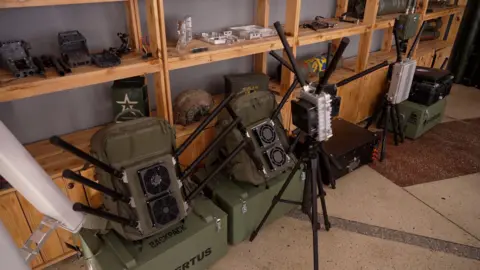
Ukrainian drone manufacturers have confirmed that Gulf states have indeed shown interest. Companies like Kvertus, specializing in anti-drone electronic warfare systems, have reportedly been approached by Saudi Arabia and Kuwait. However, their ability to export hinges on government approval from Kyiv. "We are waiting for approval to export any products. We understand that we need to coordinate with our government because it's not only about business, about selling drones, it's about politics," Yaroslav Filimonov, CEO of Kvertus, told the BBC. This illustrates the complex interplay between commercial interests and national security imperatives.
Volodymyr Zinovsky, CEO of TAF Industries, another Ukrainian drone manufacturer, echoed this sentiment, expressing willingness to delay export deals if necessary. "All of us are working to protect Ukraine, to stay with Ukraine and to keep Ukraine alive. This is about survival. And if we need to wait a few months, we will," he told the BBC, underscoring the unified national effort to defend the homeland. His company has also been approached by representatives from Saudi Arabia, Qatar, the United Arab Emirates, and Kuwait, but has directed them to engage with the Ukrainian government.
Shifting Global Alliances and the Drone Market
This diplomatic outreach from Ukraine occurs against a backdrop of increasingly complex geopolitical realignments. Recent media reports suggest that the United States is contemplating redirecting some arms intended for Ukraine to the Middle East, particularly in light of escalating tensions related to Iran. The Washington Post cited sources indicating that the Pentagon is considering such a move due to the depletion of critical munitions caused by the ongoing conflict. Such a diversion, if it occurs, would make Ukraine's pursuit of alternative defense partnerships and its own arms sales even more critical.
President Trump, when asked about potential arms diversions, acknowledged the practice as a routine aspect of U.S. foreign policy, stating, "We do that all the time. Sometimes we take from one, and we use for another." This statement, while perhaps intended to signal flexibility, underscores the precariousness of relying solely on existing aid pipelines, especially when global crises multiply and compete for limited resources. Ukraine’s proactive engagement with the Gulf states, therefore, represents a shrewd strategic maneuver to diversify its support base and secure vital military assets.
Our Take: A Necessary Evolution in Ukraine's Defense Strategy
In our assessment, Ukraine's pivot towards leveraging its drone expertise for international partnerships is not merely a business opportunity; it's a vital evolution of its defense strategy. Facing an existential threat and the potential for shifting Western priorities, Kyiv must explore all avenues to secure the resources needed to defend its sovereignty. The war has undeniably accelerated Ukraine's development and deployment of advanced drone technology, transforming it into a global leader in this domain. By offering this expertise to nations like Saudi Arabia, Ukraine not only strengthens its own position by potentially securing crucial air defense systems but also builds goodwill and establishes itself as a key security partner in a volatile region. This approach demonstrates resilience and strategic foresight, moving beyond a purely recipient role to become a contributor in the global security architecture.
Frequently Asked Questions (FAQ)
What is Ukraine offering Saudi Arabia?
Ukraine is offering its advanced drone technology and operational experience to enhance security in the Gulf region, particularly in areas related to energy infrastructure.
What does Ukraine hope to gain in return?
Ukraine is seeking to acquire much-needed air defense missile systems from Middle Eastern states to bolster its defenses against Russian attacks.
Have Ukrainian drone companies been approached by Gulf states?
Yes, several Ukrainian drone manufacturers have reported being approached by representatives from Saudi Arabia, Kuwait, Qatar, and the UAE, but await government approval for exports.
Why is the US considering diverting arms from Ukraine?
Media reports suggest the US may divert arms to the Middle East due to escalating tensions with Iran and the depletion of critical munitions within its own military stocks.
Ukraine's strategic offer of drone expertise to Saudi Arabia highlights a dynamic shift in global defense diplomacy, seeking crucial air defense systems while solidifying its role as a key technological partner. The escalating global demand for advanced drone capabilities presents both an opportunity and a necessity for Ukraine's continued fight for survival.
So here's the real question — as Ukraine proves its mettle on the battlefield and in the innovation labs, can it successfully translate this into sustainable, long-term security partnerships that transcend the immediate conflict and reshape global defense dynamics?
This article was independently researched and written by Hussain for 24x7 Breaking News. We adhere to strict journalistic standards and editorial independence.
Comments
Post a Comment