Reporting for 24x7 Breaking News. In a dramatic escalation that has sent shockwaves through global energy markets, Iran has intensified its attacks across the Persian Gulf region, striking major industrial sites in the United Arab Emirates and Bahrain. The assaults, now entering their fifth week of broader conflict involving the US and Israel, have wounded employees at key manufacturing facilities and raised serious concerns about the stability of vital shipping routes.
- Industrial Infrastructure Under Fire
- Economic Ramifications and Strait of Hormuz Tensions
- A Region Gripped by Escalation
- The Real-World Impact on Global Commerce
- Our Editorial Perspective: A Dangerous Game of Chicken
- Frequently Asked Questions (FAQ)
- What is the Strait of Hormuz?
- Why are industrial sites being targeted?
- What is the role of the Houthi movement in this conflict?
Industrial Infrastructure Under Fire
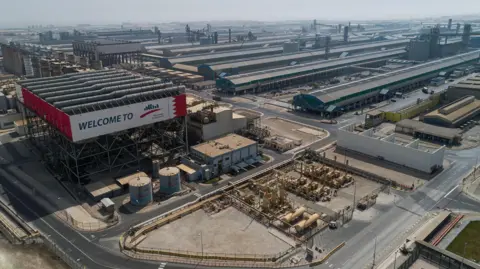
Aluminium Bahrain confirmed that its sprawling facility, one of the world's largest aluminum smelting operations, was targeted by Iran, resulting in injuries to two employees. Similarly, the United Arab Emirates reported that a significant Iranian strike hit a critical aluminum plant in Abu Dhabi, operated by Emirates Global Aluminium. The attacks have caused substantial damage, underscoring the growing reach of the conflict beyond traditional battlegrounds.
These strikes follow the recent entry of Yemen's Iran-backed Houthi movement into the wider conflict. The Houthis claimed responsibility for launching a barrage of missiles aimed at what they described as "sensitive" Israeli military sites, vowing to continue their operations. Israel, for its part, stated it intercepted two projectiles originating from Yemen. The potential for the Houthis to target shipping in the Red Sea, a crucial artery for global trade, looms large, threatening further economic disruption.
Economic Ramifications and Strait of Hormuz Tensions
The ongoing hostilities have already precipitated a surge in oil and gas prices. Iran's perceived control over the Strait of Hormuz, a critical chokepoint for global energy supplies connecting the Persian Gulf to the Gulf of Oman, has effectively disrupted maritime traffic. Analysts warn that any direct targeting of shipping by the Houthis, mirroring their actions in support of Hamas following the October 7th attacks on Israel, could send energy prices spiraling to unprecedented levels.
The ripple effects are being felt across the region. Oman is investigating what it termed "cowardly attacks" on its southern port of Salalah, where a foreign worker was reportedly injured by a drone strike. No group has yet claimed responsibility for this incident. Meanwhile, Kuwait's defense ministry reported significant damage to the radar system at its international airport, attributing the destruction to an attack involving 15 drones.
Adding another layer of complexity, Tehran has accused Israel of striking two of its steel production facilities. In retaliation, Iran's Islamic Revolutionary Guard Corps (IRGC) has issued stern warnings, threatening reciprocal action against the United States and Israel. They declared that Israeli and American universities in the Middle East would be considered legitimate targets until Iran's own academic institutions are no longer struck.
A Region Gripped by Escalation
Meanwhile, Israel has continued its offensive operations against targets in Iran and Lebanon. On Saturday, journalists reported that media workers were killed in what they described as a targeted Israeli strike. The Israel Defense Forces (IDF) confirmed the death of Ali Shoeib, an employee of Hezbollah-affiliated Al Manar TV, whom they identified as a "terrorist" belonging to Hezbollah's elite Radwan Force, alleging he had operated "under the guise of a journalist" for years. The IDF provided no substantiating evidence for these claims regarding Shoeib's alleged military role and did not comment on the deaths of other individuals, Fatima and Mohamed Ftouni, who were also reportedly killed in the incident.
The human toll in Lebanon continues to mount. The World Health Organization reported that nine paramedics lost their lives in southern Lebanon within a single 24-hour period, bringing the total number of health personnel killed in March alone to 51. These tragic losses highlight the profound humanitarian cost of the escalating conflict.
The Real-World Impact on Global Commerce
The coordinated strikes on industrial infrastructure in the Gulf are more than just regional skirmishes; they represent a direct assault on the global supply chain and economic stability. Companies like Aluminium Bahrain and Emirates Global Aluminium are not just local entities; they are critical nodes in the international production of essential materials. Damage to these facilities can lead to production halts, impacting downstream industries from automotive to aerospace and construction worldwide.
For everyday Americans, this translates directly into higher energy costs at the pump and potentially increased prices for goods manufactured using aluminum and other industrial metals. The disruption of the Strait of Hormuz, through which a significant portion of the world's oil passes, creates volatility that even distant consumers cannot escape. The specter of further price hikes looms, impacting household budgets and contributing to inflationary pressures. As we've seen with disruptions in other sectors, such as the volatile [Airfares Soar and Airports Implode: Is the Summer Travel Season Already a Washout?](https://24x7-breakingnews.blogspot.com/2026/03/airfares-soar-and-airports-implode-is.html), geopolitical instability has tangible, immediate economic consequences for ordinary citizens.
Our Editorial Perspective: A Dangerous Game of Chicken
In our assessment, the current trajectory of conflict in the Middle East is deeply concerning, reflecting a dangerous game of chicken with potentially catastrophic global consequences. The deliberate targeting of industrial infrastructure, beyond its immediate economic impact, signals a strategic intent to inflict maximum disruption. It's a tactic that weaponizes global interdependence, holding economies hostage to regional disputes. We've observed similar patterns where technological advancements, like those seen in content creation through platforms discussed in [AI's 'Fruit Love Island' Captivates Millions, Sparks Debate Over Digital Content](https://24x7-breakingnews.blogspot.com/2026/03/ais-fruit-love-island-captivates.html), can be used for both benign and harmful purposes. Here, the harm is undeniable and far-reaching.
The rhetoric of targeting universities, while framed as retaliation, crosses a perilous line, potentially igniting further cycles of violence and further destabilizing an already volatile region. The international community must urgently find pathways to de-escalation, prioritizing diplomatic solutions over military posturing. The human cost, measured in lives lost and livelihoods shattered, is simply too high to continue on this destructive path. We must advocate for peace and human dignity above all else, recognizing that economic stability is intrinsically linked to global security.
Frequently Asked Questions (FAQ)
What is the Strait of Hormuz?
The Strait of Hormuz is a narrow waterway connecting the Persian Gulf to the Gulf of Oman, serving as a critical chokepoint for global oil and gas shipments. Approximately 30% of the world's seaborne oil trade passes through it.
Why are industrial sites being targeted?
Targeting industrial sites aims to inflict economic damage, disrupt supply chains, and create widespread instability. This strategy can exert pressure on opposing nations and influence global markets.
What is the role of the Houthi movement in this conflict?
The Houthi movement, aligned with Iran, has entered the conflict by launching missile attacks against Israel, raising concerns about their potential to disrupt international shipping, particularly in the Red Sea.
The escalating attacks on industrial sites and the broader regional conflict are pushing global energy prices higher and threatening vital trade routes. Iran's escalating aggression in the Gulf is creating a volatile economic climate that impacts everyone.
So here's the real question — at what point does the international community shift from observing this dangerous escalation to actively intervening to prevent a wider economic catastrophe?This article was independently researched and written by Hussain for 24x7 Breaking News. We adhere to strict journalistic standards and editorial independence.
Comments
Post a Comment