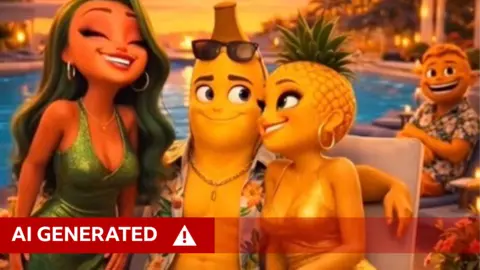
Reporting for 24x7 Breaking News. A digital phenomenon is rapidly reshaping the landscape of viral content, as an AI-generated reality dating show, dubbed 'Fruit Love Island,' has exploded onto TikTok, amassing hundreds of millions of views and millions of followers in under a month. This peculiar series, featuring anthropomorphic fruits as contestants, parodies the popular human-centric show "Love Island" and has become a lightning rod for discussions about the future of digital entertainment and the proliferation of AI-generated "slop." The anonymous creator behind the viral sensation claims significant effort goes into scripting and refining the nonsensical, one-minute episodes, a defense met with skepticism by critics who decry the content as soulless and indicative of declining human attention spans.
- The Rise of the Pixelated Plum
- Echoes of Reality, Reimagined by Algorithms
- A Digital Divide: Entertainment or Empty Calories?
- Our Editorial Perspective: The Allure and Alarm of AI-Fruity Futures
- Frequently Asked Questions (FAQ)
- What is Fruit Love Island?
- Who created Fruit Love Island?
- Why is Fruit Love Island controversial?
The Rise of the Pixelated Plum
The premise is as bizarre as it is captivating: a cast of talking fruits, including a plum named Plumero, a watermelon called Watermelina, Bananito the banana, and Cherrita the cherry, navigate the treacherous waters of romance and rivalry on a sun-drenched island. The AI-generated narratives mimic the dramatic tropes of reality dating shows, complete with arguments, blossoming romances, and even simulated physical altercations. This digital concoction has proven remarkably potent, drawing in a massive audience and even gaining the attention of celebrities like Joe Jonas and Zara Larsson, who have publicly expressed their amusement and engagement with the series.
The account responsible, ai.cinema021, has seen an astronomical surge in followers, reaching 3.3 million. While some viewers are enthralled by the absurdity and novelty, others dismiss it as derivative and lacking genuine creativity, a symptom of what they term "AI slop." This division highlights a broader societal debate about the value and authenticity of AI-generated art and entertainment. The rapid ascent of such content raises questions about our evolving media consumption habits and the impact of artificial intelligence on creative industries.
Echoes of Reality, Reimagined by Algorithms
The success of 'Fruit Love Island' is not an isolated incident. It follows a trend of AI food-related content that has gained significant traction on platforms like TikTok. This phenomenon extends beyond mere parodies; spin-offs are already emerging, such as an AI papaya character named "Anaya Papaya" that appears to be modeled after former "Love Island USA" contestant Amaya Espinal. Espinal herself expressed her discomfort with the AI reinterpretation of her reality TV experience, stating, "I don't support it... That's too crazy." Her sentiment is echoed by some, who see these AI creations as exploitative or disrespectful to the human creators and participants involved in the original shows. Indeed, the ease with which AI can replicate and remix existing content raises complex questions about intellectual property and originality.
However, the creators of 'Fruit Love Island' have pushed back against the criticism, asserting that significant human effort is invested in scripting, scene planning, and iterative refinement due to the inherent challenges of AI generation. This defense challenges the notion that AI content is purely automated and effortless, suggesting a more complex interplay between human direction and machine execution. The debate over the labor and creativity involved in AI-generated media is far from settled.
A Digital Divide: Entertainment or Empty Calories?
Digital culture and technology expert Jessa Lingel from the University of Southern California criticizes such content as fundamentally "bad" and a prime example of "AI slop." Lingel argues that these AI-generated shows cater to increasingly short attention spans, offering a "shortened, sensationalized AI slop version" of existing entertainment that requires minimal cognitive engagement from the viewer. This perspective taps into concerns about the potential degradation of critical thinking and sustained attention in a digital age saturated with easily digestible, algorithmically optimized content. The ease with which these AI shows can be consumed mirrors concerns previously raised about the superficiality of certain entertainment trends, much like the focus on celebrity mishaps that can sometimes overshadow more substantive news, a point our team has touched upon in analyzing the impact of sensationalism in media.
The creators of 'Fruit Love Island' have seen several episodes removed by TikTok, with the reasons remaining unclear, though similar content is now available on YouTube. This platform moderation adds another layer of complexity, hinting at the challenges of policing AI-generated content and its adherence to community guidelines. As platforms grapple with the deluge of AI-created material, questions about censorship, content moderation, and the very definition of originality will only intensify. This situation also brings to mind the ongoing discussions around digital misinformation and the potential for AI to be used in more nefarious ways, such as the creation of deepfakes, a concern that has affected public figures and caused significant distress, as we reported in the case of a German TV star facing threats after a deepfake scandal.
Our Editorial Perspective: The Allure and Alarm of AI-Fruity Futures
In our assessment, the viral success of 'Fruit Love Island' is a fascinating, albeit unsettling, indicator of where digital culture is heading. It's easy to dismiss these fruit-based dramas as pure absurdity, but their ability to capture the zeitgeist and millions of eyeballs speaks volumes about what resonates in the current media environment. While the creators insist on the hours of work involved, the underlying technology allows for a rapid iteration and dissemination of content that feels both novel and eerily familiar. What concerns us most is not the existence of 'Fruit Love Island' itself, but what it represents: a potent symbol of how AI is democratizing content creation, for better or worse. It has the potential to empower new voices and creative avenues, but also to flood our digital spaces with low-effort, derivative material that prioritizes virality over substance. We must ask ourselves if this is merely harmless fun or a harbinger of a future where genuine human creativity is increasingly devalued in favor of algorithmic mimicry. The ethical implications, from intellectual property to the psychological impact of consuming such content, demand serious consideration. This trend also highlights how technology can both amplify and distort human connection and entertainment, a theme relevant to broader societal shifts.
Frequently Asked Questions (FAQ)
What is Fruit Love Island?
Fruit Love Island is a viral reality dating show series created entirely by generative artificial intelligence, featuring anthropomorphic fruit characters that mimic the format and drama of the human reality show "Love Island."
Who created Fruit Love Island?
The series is produced by an anonymous creator or group operating under the TikTok account ai.cinema021. They have stated that significant human effort is involved in scripting and refining the episodes.
Why is Fruit Love Island controversial?
It has sparked debate as some critics dismiss it as low-quality "AI slop" lacking originality and soul, while others see it as a concerning trend that may devalue human creativity and cater to shortened attention spans. There are also concerns about potential spin-offs and the ethics of AI reinterpreting existing content.
The rapid rise of AI-generated content like 'Fruit Love Island' underscores a significant shift in digital media consumption, blending viral appeal with profound questions about creativity and authenticity. So, as AI becomes more adept at mimicking human creativity, where do we draw the line between harmless digital fun and the erosion of genuine artistic expression?
This article was independently researched and written by Hussain for 24x7 Breaking News. We adhere to strict journalistic standards and editorial independence.
Comments
Post a Comment