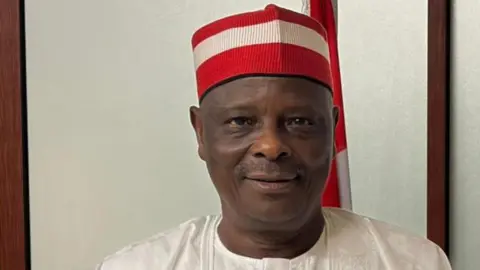
Reporting for 24x7 Breaking News. Nigeria’s political landscape is in flux once again, with a significant jolt delivered by the defection of prominent opposition figure Rabiu Musa Kwankwaso to the African Democratic Congress (ADC). This strategic realignment, announced Monday, less than a year before the January 2027 general election, injects a potent new dynamic into the race to unseat President Bola Tinubu and his All Progressives Congress (APC).
- A Political Heavyweight Shifts Allegiance
- Navigating the Presidential Candidacy Question
- Broader Political and Social Context
- The Real-World Impact: Stability and Choice
- Frequently Asked Questions (FAQ)
- Who is Rabiu Kwankwaso?
- Which party did Kwankwaso join?
- What was Kwankwaso's previous party affiliation?
- Who are the other major opposition figures in the ADC?
A Political Heavyweight Shifts Allegiance
Kwankwaso, a former governor of Kano State and a presidential aspirant in the 2023 election where he finished fourth, revealed his new political home via social media, simply stating, "New dawn. We are ADC." This move follows his abrupt resignation from the New Nigeria People's Party (NNPP), a party he led. His departure was framed as a necessary "strategic realignment" in response to the "current trajectory of the nation's political landscape," suggesting a perceived lack of opportunity for meaningful change within his former party.
The ADC, already positioning itself as a formidable challenger, has now become the focal point for a coalition of opposition heavyweights. Former Vice-President Atiku Abubakar and ex-state governor Peter Obi, who were President Tinubu’s main rivals in the last election, are also key figures within the emerging ADC alliance. Kwankwaso’s arrival significantly bolsters the coalition’s profile and reach, particularly in the crucial Muslim-majority northern regions of Nigeria, a demographic that wields considerable influence in national elections.
His supporters, famously known as the Kwankwasiyya movement, are recognizable by their distinctive red caps and have demonstrated remarkable loyalty, following Kwankwaso through several party affiliations over the years. The visual of hundreds gathered at a rally, many sporting these red caps and celebrating his welcome to the ADC, underscores the substantial grassroots support he commands.
Navigating the Presidential Candidacy Question
However, the influx of such prominent figures into the ADC presents its own set of challenges, chief among them being the selection of a single presidential candidate. With Abubakar, Obi, and now Kwankwaso all having credible presidential ambitions and substantial followings, the question of who will lead the party into the 2027 election looms large. This internal dynamic could prove to be a critical juncture, with the potential for internal splits if a consensus cannot be reached.
Kwankwaso’s past experience as a former defense minister also adds a layer of strategic depth to the ADC’s platform, especially as Nigeria grapples with persistent security challenges. This background could resonate with voters looking for leadership with a proven track record in national security matters.
Speculation about Kwankwaso’s potential move had been circulating for some time. Hours before his official announcement, hundreds of his supporters were seen gathered outside his residence, waving ADC flags. Photos shared by Kwankwaso himself showed him receiving senior ADC officials at his home in Kano, further fueling the rumors.
Broader Political and Social Context
This political reshuffling occurs against a backdrop of internal strife within other major opposition parties. The People’s Democratic Party (PDP) is reportedly fractured into rival factions, diminishing its historical standing as the country’s primary opposition bloc. Similarly, the Labour Party has faced its own internal challenges, creating an opening for the ADC to consolidate opposition forces.
In parallel, Nigeria's electoral commission has been implementing reforms following concerns raised after the disputed 2023 vote. New regulations mandate the electronic transmission of results from polling stations in real-time. Nevertheless, opposition parties have voiced reservations about provisions allowing manual vote sorting in areas with limited internet access, raising concerns about potential impacts on transparency. This move highlights the ongoing efforts to refine electoral processes, a critical aspect of democratic health.
We came across this story via BBC Africa, which initially reported on the political developments. The Nigerian government has consistently denied allegations of targeted religious persecution, stating that violence affects all faith communities and is often driven by factors beyond religious affiliation. The NNPP had previously condemned any suggestion of Kwankwaso’s involvement with religious extremism, labeling such claims as unfounded.
The broader implications for Nigeria's political future are significant. A unified and strong opposition could present a more formidable challenge to the incumbent APC. However, the internal cohesion of the ADC, particularly regarding its presidential nomination, will be a critical factor to watch as the 2027 election approaches. This development also echoes broader trends in global politics where established parties are constantly being challenged by new alliances and shifting allegiances, much like the strategic calculations seen in geopolitical arenas, such as the complex US military considerations for Kharg Island.
The Real-World Impact: Stability and Choice
For ordinary Nigerians, this political maneuvering translates directly into the perceived strength and viability of the opposition. A fragmented opposition offers voters fewer credible alternatives, potentially leading to voter apathy or a sense of disempowerment. Conversely, a well-organized and unified ADC, bolstered by figures like Kwankwaso, could invigorate the electorate and present a more competitive contest, offering greater choice and potentially influencing policy debates on critical issues like economic development and security.
The shift also highlights the personalized nature of Nigerian politics, where the charisma and following of individual politicians often transcend party lines. The loyalty of the Kwankwasiyya movement, for instance, demonstrates how deeply intertwined support can be with specific leaders, rather than abstract party platforms. This dynamic can be both a source of strength for parties and a potential point of instability if leaders make unexpected moves.
The upcoming election cycle will undoubtedly be closely watched, not only within Nigeria but also by international observers interested in the stability and democratic progress of Africa's most populous nation. The ability of the opposition to coalesce effectively will be a key determinant in the political future. It’s a reminder that political landscapes can change rapidly, much like sudden legal decisions impacting large sums, such as the dismissal of Cardiff City's claim.
Frequently Asked Questions (FAQ)
Who is Rabiu Kwankwaso?
Rabiu Musa Kwankwaso is a prominent Nigerian politician, a former governor of Kano State, and a former presidential aspirant. He is known for his loyal following, the Kwankwasiyya movement.
Which party did Kwankwaso join?
Rabiu Kwankwaso announced on Monday that he has joined the African Democratic Congress (ADC).
What was Kwankwaso's previous party affiliation?
Kwankwaso was previously a leader and member of the New Nigeria People's Party (NNPP) before resigning from the party.
Who are the other major opposition figures in the ADC?
Former Vice-President Atiku Abubakar and ex-state governor Peter Obi are also key figures who have joined the ADC coalition.
The Nigerian political arena has seen a seismic shift with Kwankwaso's move to the ADC, significantly reshaping the opposition's challenge for the 2027 presidential election. The consolidation of opposition power within the ADC sets the stage for a potentially more competitive electoral contest.
So, the critical question remains: Can this newly formed coalition of opposition titans within the ADC overcome internal rivalries and present a truly unified front capable of defeating the incumbent APC in the 2027 presidential elections?
This article was independently researched and written by Hussain for 24x7 Breaking News. We adhere to strict journalistic standards and editorial independence.
Comments
Post a Comment