Reporting for 24x7 Breaking News. The Republic of Maldives has officially informed the United Kingdom that it does not recognize the recently struck deal transferring sovereignty of the Chagos Islands to Mauritius. President Mohamed Muizzu's administration has lodged formal objections, asserting historical and geographical ties to the archipelago and signaling potential international legal action to assert its claim.
- Maldives Formalizes Opposition to Chagos Transfer
- A Contested History and International Rulings
- Geopolitical Crossroads and Uncertain Futures
- The Real-World Impact: Sovereignty and Stability
- An Editorial Perspective on Historical Justice
- Frequently Asked Questions (FAQ)
- What is the Chagos Archipelago?
- Why is the Maldives challenging the UK-Mauritius deal?
- What is the significance of the Chagos Islands?
- What are the potential next steps?
Maldives Formalizes Opposition to Chagos Transfer
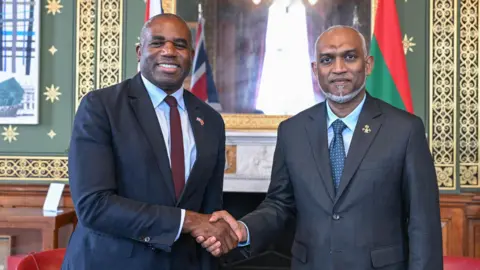
In a significant diplomatic maneuver, the Maldives has made its stance unequivocally clear to the UK government. The President's Office confirmed to the BBC that the nation has issued two written objections and engaged in direct communication, including a phone call with Deputy Prime Minister David Lammy, to express its profound concerns. The Maldivian government views the UK's agreement with Mauritius as a unilateral decision that disregards its own legitimate interests and historical claims.
The statement from President Muizzu's office articulated a firm position: "The decision by the British government to proceed in sole consultation with Mauritius - without due consideration of Maldivian interests - is deeply concerning." Consequently, the Maldives has formally communicated that it does not recognize the transfer of the Chagos Archipelago to Mauritius. This stance, the statement added, is “based on the profound historical and administrative ties between the Maldives and the archipelago, as well as the significant implications any such transfer holds for Maldivian sovereignty.”
A Contested History and International Rulings
The Chagos Islands, officially designated as the British Indian Ocean Territory (BIOT), have been under UK control since the early 19th century. However, Mauritius has long asserted its claim, citing historical and geographical proximity. International legal bodies have increasingly sided with Mauritius in recent years. In 2023, the International Tribunal for the Law of the Sea (ITLOS) reinforced the International Court of Justice's (ICJ) 2019 advisory opinion. The ICJ had ruled that the UK's 1965 detachment of the Chagos Islands from Mauritius was unlawful and mandated an end to its administration.
While advisory opinions are not legally binding in the same way as court judgments, they carry substantial legal and political weight. The UN General Assembly responded to the ICJ's opinion by demanding the archipelago's return to Mauritius in a near-unanimous vote in 2019. The Maldives government indicated it is meticulously reviewing these international legal pronouncements, suggesting they may form the basis for its own legal challenges.
The Maldivian government maintains that, by virtue of historical and geographical proximity, it holds a prior claim to sovereign rights over the Chagos Archipelago over any other state. "Accordingly, if sovereignty is to be vested in any nation, it must rightfully be the Maldives," the statement declared. The nation is reportedly exploring all available avenues for a formal submission to the ICJ and assessing all lawful means to uphold its national interest.
Geopolitical Crossroads and Uncertain Futures
The UK's agreement with Mauritius to transfer sovereignty included a provision for a joint UK-US military base on Diego Garcia, the largest island. The UK has been paying an estimated £101 million annually to lease this strategic location. Labour ministers had argued that securing a deal with Mauritius was crucial to ensure the future of this vital military installation, suggesting that failure to do so could jeopardize its operational status amidst ongoing international legal pressures.
However, the transfer has been thrown into considerable doubt not only by the Maldives' intervention but also by comments from former US President Donald Trump. In February, Trump urged Prime Minister Sir Keir Starmer not to relinquish the territory, posting on Truth Social that "this land should not be taken away from the UK." This intervention came despite the U.S. Department of State having officially backed the UK's plan. The deal remains unconfirmed in UK law and appears to be indefinitely stalled.
The situation highlights the complex geopolitical dynamics at play in the Indian Ocean. The Maldives' assertiveness underscores the growing assertiveness of smaller nations on the international stage, challenging established colonial-era arrangements. This dispute could potentially escalate into a significant international legal battle, further complicating the UK's foreign policy objectives and its relationship with both Mauritius and the Maldives.
The historical context of colonial powers drawing arbitrary lines on maps, disregarding indigenous populations and existing claims, resonates deeply here. It echoes broader struggles for self-determination and historical justice, reminiscent of the enduring fight against the legacies of the transatlantic slave trade, which the UN has rightly declared a crime against humanity. UN Declares Transatlantic Slave Trade a Crime Against Humanity. The principle of respecting historical ties and the sovereignty of nations, regardless of their size or influence, remains a critical benchmark for international relations.
The Real-World Impact: Sovereignty and Stability
For the people of the Maldives, this is not merely an abstract legal or geopolitical dispute; it is about national sovereignty and historical identity. The potential assertion of control over the Chagos Islands, which they believe are rightfully theirs, touches upon a deep sense of national pride and historical connection. The uncertainty surrounding the UK-Mauritius deal, now amplified by the Maldivian challenge and Trump's intervention, creates a climate of instability that could have ripple effects across the region.
Furthermore, the protracted legal and diplomatic wrangling over the Chagos Islands could impact regional security and international cooperation. The implications for the crucial joint military base are significant, potentially affecting global strategic calculations. The situation serves as a stark reminder of how historical colonial decisions continue to create complex challenges in the present day, demanding careful and equitable resolution.
An Editorial Perspective on Historical Justice
In our view, the Maldives' challenge to the UK-Mauritius deal brings a long-overdue spotlight to the complexities of post-colonial territorial disputes. While international courts have leaned towards Mauritius, the Maldivian insistence on its own historical and geographical claims cannot be easily dismissed. The core issue here is the principle of self-determination and the rectification of historical injustices. It is imperative that the United Kingdom engages in genuine dialogue with all parties involved, ensuring that any resolution is not only legally sound but also respects the legitimate aspirations and historical narratives of the Maldivian people. Ignoring these claims risks perpetuating a cycle of international disputes rooted in past colonial actions.
Frequently Asked Questions (FAQ)
What is the Chagos Archipelago?
The Chagos Archipelago, also known as the British Indian Ocean Territory (BIOT), is a group of islands in the Indian Ocean, currently administered by the United Kingdom.
Why is the Maldives challenging the UK-Mauritius deal?
The Maldives asserts historical and geographical claims to the islands, stating the UK's agreement with Mauritius did not adequately consider Maldivian interests and sovereignty.
What is the significance of the Chagos Islands?
The islands host a strategically important joint UK-US military base on Diego Garcia, making their sovereignty a matter of significant geopolitical interest.
What are the potential next steps?
The Maldives government has indicated it is reviewing international legal rulings and exploring options for submitting its claims to the International Court of Justice (ICJ), potentially leading to further legal and diplomatic challenges.
The Maldives' firm stance and threat of legal action against the UK-Mauritius Chagos Islands deal underscore a critical moment for sovereignty and international law. Maldives formalizes opposition to the transfer, setting the stage for a potentially protracted legal and diplomatic showdown.
So here's the real question — in an era demanding historical reckoning and respect for all nations, how can the international community ensure that territorial disputes are resolved equitably, prioritizing genuine dialogue and justice over lingering colonial arrangements?
This article was independently researched and written by Hussain for 24x7 Breaking News. We adhere to strict journalistic standards and editorial independence.
Comments
Post a Comment