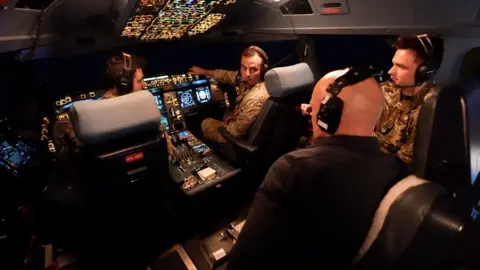
Reporting for 24x7 Breaking News. The skies above RAF Akrotiri in Cyprus are alive with the thunderous roar of advanced jet engines, a nightly ballet of defense against a persistent threat. British F-35 and Typhoon fighter jets, symbols of aerial dominance, are being kept airborne by the Royal Air Force's Voyager, a colossal air-to-air refueling tanker serving as a critical lifeline in the tense Eastern Mediterranean. This operation, codenamed 'Operation Luminous,' underscores the United Kingdom's significant role in regional security amidst escalating tensions stemming from recent U.S. and Israeli actions against Iran.
- The High-Stakes Aerial Dance: Keeping Fighters in the Fight
- The Costly Business of Drone Defense
- Bolstering Defenses in a Vulnerable Hotspot
- The Human Reality: A Constant State of Alert
- Our Take: A Shield in the Storm, But at What Cost?
- Frequently Asked Questions (FAQ)
- What is Operation Luminous?
- Why is the RAF Voyager tanker important?
- What are the main threats faced by RAF Akrotiri?
- How has RAF Akrotiri's defense been enhanced?
The High-Stakes Aerial Dance: Keeping Fighters in the Fight
From the pressurized confines of the Voyager's cockpit, journalists recently witnessed firsthand the intricate dance that allows these formidable fighter jets to patrol for hours on end. As the shimmering lights of Cyprus faded behind them, the aircraft navigated towards the coastlines of Israel and Lebanon. Crew members pointed out brief flashes of orange light, potential indicators of incoming missiles or Israeli defensive responses, a stark reminder of the volatile geopolitical landscape. The pilot, speaking over the intercom, acknowledged the uncertainty but noted the significant kinetic activity in the region, a clear sign that the threat from Iranian drones and missiles remains potent.
During a single nine-hour mission observed, the Voyager facilitated seven crucial refueling operations, delivering approximately 30 tonnes of aviation fuel to the fighter jets. These aircraft, appearing as streaks of light against the darkness, executed delicate maneuvers to connect with the fuel hose trailing from the tanker's wing. For the pilots, this aerial refueling is a routine, albeit complex, part of maintaining an extended combat air patrol. The true challenge, however, lies in identifying and neutralizing the low-flying, slow-moving Iranian drones, a task that has seen British jets successfully down several over the past month operating from bases in Cyprus and Qatar.
The Costly Business of Drone Defense
While the exact number of times sophisticated Advanced Short-Range Air-to-Air Missiles (ASRAAM) have been deployed against drones remains undisclosed, sources indicate it's in the single digits. This highlights a significant strategic and economic disparity: the use of expensive, precision-guided munitions to neutralize relatively inexpensive, fiberglass drones. Squadron Leader "Bally," an RAF F-35 pilot, elaborated on the inherent dangers of these missions. "Operating on a fast jet is already a dangerous business," he explained, "Let alone when trying to target something close to the surface." The risk of flying too low, combined with the need to maintain separation from other aircraft operating in the congested airspace, presents a formidable tactical challenge.
The missions flown from Cyprus and Qatar are part of a broader defensive posture. Despite some criticism regarding preparedness, the UK government has maintained that adequate measures were in place. Major General Tom Bewick, Commander of British Forces Cyprus, emphasized the "prudent planning" that preceded the conflict, including the deployment of additional air defense systems and personnel. However, even with these preparations, the base at Akrotiri was not immune to attack. On the second night of the recent conflict, a small drone, likely launched from Lebanon, impacted a hangar on the U.S. Air Force section of the base.
Bolstering Defenses in a Vulnerable Hotspot
The drone, reportedly with a two-meter wingspan, was tracked by radar, allowing for air raid warnings to be sounded and personnel to be evacuated. While Major General Bewick downplayed the damage as "minimal," he acknowledged that the strike demonstrated the persistent threat. In response to this incident and the ongoing risk, Akrotiri's air defenses have been significantly enhanced. The base now hosts eight Typhoon jets and eight F-35 jets, bolstered by Wildcat helicopters equipped with short-range air defense missiles and Merlin helicopters providing early warning radar capabilities. Furthermore, the Royal Navy destroyer HMS Dragon is operating off the coast of Cyprus, providing an additional layer of formidable air defense.
Major General Bewick expressed his satisfaction with the "super high-end" warship's presence, noting that the base now possesses robust air defense capabilities. He candidly admitted that given Iran's public statements identifying RAF Akrotiri as a potential target, it would be foolish not to take such threats seriously. The base remains a realistic target, and vigilance is paramount.
The Human Reality: A Constant State of Alert
For the personnel stationed at RAF Akrotiri, and indeed for the communities in the surrounding areas, the heightened military activity represents a constant state of alert. The sight and sound of fighter jets scrambling, the reliance on advanced radar systems, and the ever-present threat of drone or missile attacks create a palpable tension. This isn't just a distant geopolitical standoff; it's a daily reality for those on the front lines of regional security. The deployment of sophisticated assets like the Voyager tanker and advanced fighter jets, while crucial for deterrence and defense, also signifies the gravity of the situation and the potential for direct conflict.
The strategic implications of maintaining such a robust air presence are far-reaching. It signals to allies the UK's commitment to regional stability and serves as a deterrent to potential aggressors. However, it also positions the base and its personnel as potential targets, a reality that commanders like Major General Bewick cannot ignore. The continuous monitoring and defensive maneuvers are a testament to the complex and often dangerous work undertaken by the Royal Air Force and its allies in a volatile part of the world.
Our Take: A Shield in the Storm, But at What Cost?
In our view, the operations over Cyprus represent a critical, albeit costly, effort to project stability in a highly volatile region. The RAF's Voyager tanker, a vital piece of logistical infrastructure, ensures that fighter jets can maintain a persistent presence, crucial for both deterrence and immediate response. While the technological prowess displayed by the F-35s and Typhoons is impressive, the underlying reality is that these advanced capabilities are being employed to counter relatively unsophisticated threats, highlighting the asymmetric nature of modern conflict. The fact that a drone could penetrate the defenses of a major military installation, even with prior warnings, is a sobering reminder that no base is entirely impregnable. We must continually question the escalating costs—both financial and human—associated with maintaining such a high level of readiness in a region teetering on the brink. The dedication of the service members involved is commendable, but it underscores a broader need for de-escalation and diplomatic solutions to prevent such costly defensive postures from becoming the norm.
Frequently Asked Questions (FAQ)
What is Operation Luminous?
Operation Luminous is the codename for the defensive missions conducted by the UK's Royal Air Force in the skies over Cyprus and Jordan, involving fighter jets and support aircraft like the Voyager tanker to counter drone threats.
Why is the RAF Voyager tanker important?
The Voyager acts as a crucial "gas station in the sky," enabling fighter jets like the F-35 and Typhoon to remain airborne for extended periods, significantly enhancing their operational range and loiter time for surveillance and defensive missions.
What are the main threats faced by RAF Akrotiri?
The primary threats include Iranian drones and missiles, as publicly stated by Iran, which has identified RAF Akrotiri as a potential target. The base has already experienced a drone strike.
How has RAF Akrotiri's defense been enhanced?
Defenses have been bolstered with additional Typhoon and F-35 jets, Wildcat helicopters with air defense missiles, Merlin helicopters with early warning radar, and the presence of the Royal Navy destroyer HMS Dragon.
The Royal Air Force's sustained operations, powered by the Voyager tanker, are a critical component of regional security, but the persistent threat of drone attacks and the high cost of defense raise significant questions. So here's the real question — can the UK's enhanced defenses truly deter continued aggression, or are they merely a costly prelude to inevitable future confrontations?
This article was independently researched and written by Hussain for 24x7 Breaking News. We adhere to strict journalistic standards and editorial independence.
Comments
Post a Comment