Reporting for 24x7 Breaking News.
- A Legacy Under Scrutiny: Abuse Allegations Surface
- California Lawmakers Lead the Charge for Renaming
- Echoes Across the Nation: Public Spaces Re-examined
- Preserving the Movement's Spirit Amidst Pain
- The Human Reality: Reclaiming the Narrative
- Editorial Perspective: A Necessary Reckoning
- Frequently Asked Questions (FAQ)
- What were the main allegations against Cesar Chavez?
- Why are people calling to rename Cesar Chavez Day?
- What is the new name for the holiday in California?
- How are artists and communities responding to the allegations?
The legacy of Cesar Chavez, a towering figure in American labor history, is undergoing a profound reassessment following disturbing allegations of sexual abuse that have surfaced in recent months. The revelations have sent shockwaves across California, a state deeply intertwined with the farm labor movement, prompting activists and lawmakers to reconsider the naming of public spaces and the very nature of the holiday that honors him.
A Legacy Under Scrutiny: Abuse Allegations Surface
The allegations, which emerged prominently in March through reporting by The New York Times, include accusations from civil rights leader Dolores Huerta, who co-founded the National Farm Workers Association with Chavez. Huerta, now 95, stated that Chavez sexually assaulted her decades ago, an act she remained silent about for years, fearing it would undermine the burgeoning farmworkers movement. The investigation also detailed similar accusations from two other women, who claimed Chavez molested them as minors in the 1970s.
These claims have cast a long shadow over the celebrated memory of Chavez, a man whose organizing efforts in the 1960s, particularly the Delano grape strike, led to significant improvements in wages and working conditions for agricultural laborers. His iconic slogan, "¡Sí, se puede!" ("Yes, we can!"), became a rallying cry for generations of activists and was even adopted by Barack Obama's presidential campaign.
California Lawmakers Lead the Charge for Renaming
The personal toll of these revelations is keenly felt by those with deep roots in the agricultural heartland. State Senator Suzette Martinez Valladares, whose family has a history of working in the fields, articulated this sentiment during a legislative discussion. "As the daughter and granddaughter of farmworkers, this is deeply personal," she stated, emphasizing that the legacy of all farmworkers, not just one individual, should be honored. "The legacy of farmworkers belongs to families like mine across California—not to any one individual."
This sentiment has translated into tangible action. In a significant move, California lawmakers recently voted unanimously to rename the state holiday from Cesar Chavez Day to Farmworkers Day. This legislative shift reflects a broader desire to honor the collective struggle and contributions of countless individuals who have toiled in the fields, often under arduous conditions, rather than solely focusing on a figure now associated with serious misconduct.
Echoes Across the Nation: Public Spaces Re-examined
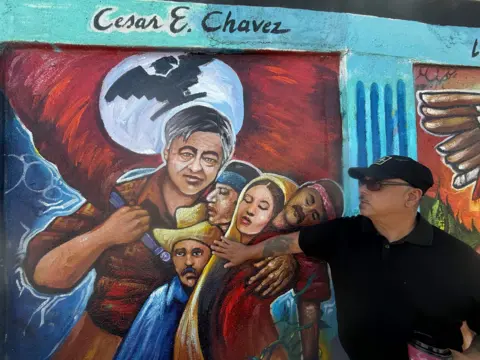
The re-evaluation is not confined to California's state holiday. Across the United States, dozens of schools, streets, and public buildings bear Chavez's name. There are growing movements and discussions in various communities to rename these landmarks. Statues are being removed, and murals are being altered or vandalized, signaling a palpable shift in public perception and a demand for accountability.
This national reckoning is also being felt in the art community. In Los Angeles's Watts neighborhood, artist MisterAlek, who previously painted a mural of Chavez in 2021, has transformed the artwork into a tribute to Dolores Huerta. "After learning about all the new allegations and all the new stuff that came out, I felt somewhat responsible of changing the mural because it's my art piece, right, I created it," MisterAlek told a local ABC News affiliate. His revised mural now celebrates Huerta's lifelong activism and her role as a vocal advocate for rights. This act underscores the evolving narrative, where the focus shifts to other pivotal figures who championed the cause.
Preserving the Movement's Spirit Amidst Pain
Despite the painful revelations, many acknowledge the critical role Chavez played in advancing labor rights and the need to continue celebrating the broader farmworker movement. Los Angeles Mayor Karen Bass expressed her devastation and described her memories of Chavez as now "painful." However, she also recognized his historical significance, stating, "It was because of people like Cesar Chavez and Martin Luther King and other leaders that I made a commitment as a child that I wanted to spend my life fighting for justice."
Some artists are advocating for a nuanced approach to memorials, suggesting renovation rather than outright removal. Artist JD "Zender" Estrada, who painted a mural in 1994 depicting Chavez alongside four farmworkers, believes historical art should be updated to reflect a more comprehensive understanding of the movement. "I'd love to bring this mural into the 21st Century," Estrada said. He proposes that murals could remain but depict Chavez with less prominence, while also better acknowledging the contributions of farmworkers from diverse backgrounds, including those from the Philippines and other nations. "I'm very sympathetic to the victims of what happened," Zender added, "But we have to preserve and conserve murals. They are important in Los Angeles." This perspective highlights the tension between acknowledging past harms and preserving historical artistic and cultural contributions.
The Human Reality: Reclaiming the Narrative
For countless families in California and across the nation, the fields represent generations of hard work, struggle, and resilience. The allegations against Chavez introduce a complex layer of trauma and re-evaluation for those who have long revered him as a symbol of liberation. The move to rename the holiday to Farmworkers Day is a powerful step towards centering the collective experience and acknowledging that the fight for justice is always a communal endeavor, requiring us to confront uncomfortable truths about historical figures.
This moment calls for a deeper understanding of the sacrifices made by all farmworkers, many of whom are immigrants and marginalized communities who continue to face exploitation and challenging working conditions. The efforts to re-examine the narrative are not about erasing history, but about ensuring that the stories we celebrate are truthful, inclusive, and truly honor the dignity and enduring spirit of the people who feed our nation.
Editorial Perspective: A Necessary Reckoning
In our view, the revelations surrounding Cesar Chavez represent a critical and necessary reckoning for the labor movement and for American society at large. It is deeply painful to confront the possibility that a figure so widely celebrated for his advocacy for the oppressed may have inflicted harm on those he claimed to champion. However, history is rarely as simple as we wish it to be, and our understanding of heroes must evolve as new truths emerge.
The decision by California lawmakers to rename the holiday to Farmworkers Day is a profound and commendable step. It rightly shifts the focus from a single, flawed individual to the collective strength, resilience, and ongoing struggle of all agricultural laborers. This broader recognition is essential for acknowledging the diverse contributions from various ethnic and national backgrounds that have shaped the farmworker movement. Furthermore, it provides an opportunity to uplift and honor figures like Dolores Huerta, whose own contributions have been immense and whose voice in this re-evaluation is crucial. We believe that true progress lies not in deifying historical figures, but in critically examining their legacies, honoring the full spectrum of human experience, and ensuring that our celebrations reflect a commitment to justice for all, especially for those who continue to work under difficult conditions. This re-evaluation is not an erasure of the past, but an honest and more complete embrace of it, paving the way for a more just and truthful future.
Frequently Asked Questions (FAQ)
What were the main allegations against Cesar Chavez?
The primary allegations involve accusations of sexual abuse and molestation, including claims made by Dolores Huerta and two other women dating back to the 1970s.
Why are people calling to rename Cesar Chavez Day?
Following the serious abuse allegations, many feel it is inappropriate to continue honoring Chavez as the sole representative of the farmworker movement, leading to calls to rename the holiday to better reflect the contributions of all farmworkers.
What is the new name for the holiday in California?
California lawmakers recently voted unanimously to rename the holiday to Farmworkers Day.
How are artists and communities responding to the allegations?
Responses vary, including the removal of statues, alteration of murals, and discussions about renaming public spaces. Some artists are advocating for renovating existing artworks to offer a more nuanced historical perspective.
The reassessment of Cesar Chavez's legacy is forcing a difficult but necessary conversation about how we honor historical figures and the importance of centering the experiences of all those who contributed to social justice movements. The fight for farmworker rights continues, and the question remains: how do we best ensure that the sacrifices and struggles of the past are remembered with both honesty and a commitment to the ongoing pursuit of dignity and justice for all workers?
This article was independently researched and written by Hussain for 24x7 Breaking News. We adhere to strict journalistic standards and editorial independence.
Comments
Post a Comment