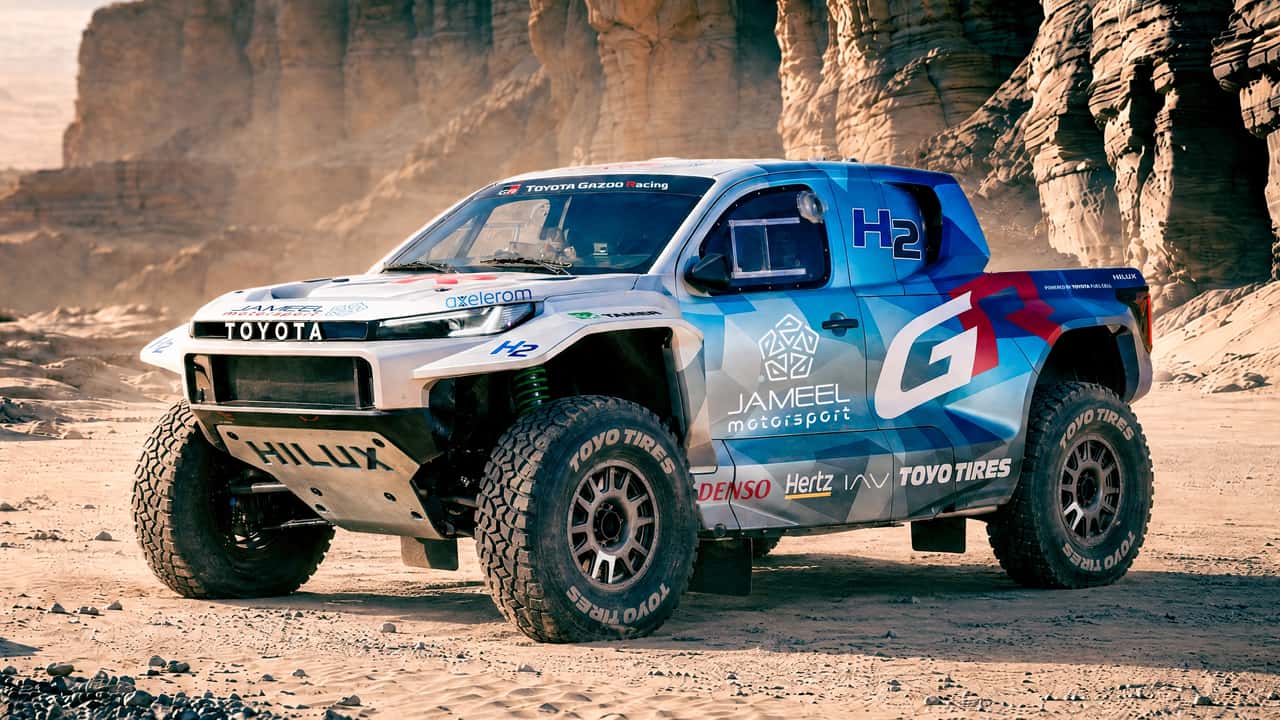
The Dakar Rally is not merely a race; it is a mechanical executioner. For decades, the grueling endurance test has chewed through diesel engines and spat out broken suspension components across the dunes of Africa, South America, and now Saudi Arabia. However, the 2027 edition of this legendary marathon is poised to witness a transformation that sounds more like science fiction than engineering reality. Reporting for 24x7 Breaking News, our editorial team has been tracking Toyota’s audacious plan to field a Hydrogen Hilux Dakar 2027 entry that aims to conquer the desert while emitting nothing but pure water vapor.
- The Engineering Under the Hood: More Than Just a Mirai in a Suit
- Survival of the Fittest: Handling the Heat and the Dust
- The Market Shift: Why Toyota is Shunning the All-Electric Trend
- Editorial Perspective: A Bold Gamble or a Distraction?
- Frequently Asked Questions (FAQ)
- Is hydrogen fuel cell technology safe for off-road racing?
- How does the range of a hydrogen Hilux compare to a diesel one?
- Where does the hydrogen come from for the Dakar Rally?
This isn't just a PR stunt. Toyota, a brand that has built its reputation on the near-indestructible nature of the Hilux, is betting its legacy on a fuel cell electric vehicle (FCEV) powertrain. In the world of off-road racing, reliability is the only currency that matters. While the industry has been obsessed with lithium-ion batteries, Toyota has quietly been refining its 'Multi-Path' strategy, arguing that in the most extreme environments on Earth, heavy batteries are a liability. By utilizing the same fundamental technology found in the Mirai sedan, but ruggedized for the most violent terrain imaginable, Toyota Gazoo Racing is attempting to prove that zero-emission racing doesn't have to mean tethering yourself to a charging cable.
The Engineering Under the Hood: More Than Just a Mirai in a Suit
To understand the sheer scale of this challenge, we have to look at the physics of Dakar. A traditional T1+ category truck faces temperatures exceeding 120 degrees Fahrenheit and vibrations that can rattle the teeth out of a driver’s head. Integrating a delicate hydrogen fuel cell stack into this environment is an engineering nightmare. Our technical analysis reveals that Toyota is likely utilizing a multi-stack configuration derived from their second-generation fuel cell technology. Unlike a battery-electric vehicle, which would require massive, heavy packs to survive a 500-mile stage, the Hydrogen Hilux Dakar 2027 relies on three high-pressure tanks storing roughly 7 kilograms of hydrogen at 700 bar.
The advantage here is twofold: weight and refueling speed. In the desert, weight is the enemy of suspension travel. By keeping the vehicle light, Toyota maintains the Hilux’s legendary agility over the 'fech-fech' (fine, powdery sand). Furthermore, refueling a hydrogen tank takes minutes, whereas charging a massive battery in the middle of the Empty Quarter would require a portable power plant. This pursuit of alternative energy is part of a broader trend we’ve seen in the tech and industrial sectors. For instance, as we explored in our report on The Power Grid War: Big Tech's Desperate Hunt for Energy, the global demand for clean, scalable power is forcing every major player—from Google to Toyota—to look beyond the standard electric grid.
Survival of the Fittest: Handling the Heat and the Dust
From the driver’s seat, the experience of a hydrogen-powered racer is eerily different. There is no roar of a V6 or the whistle of a turbocharger. Instead, there is the high-pitched hum of the air compressor and the instant, neck-snapping torque of electric motors. Our sources within the testing program suggest the truck handles with a lower center of gravity than its internal combustion predecessors, thanks to the strategic placement of the hydrogen tanks under the cabin floor. This improves stability during high-speed jumps, a critical factor when navigating the unpredictable dunes of Saudi Arabia.
However, the cooling requirements for a fuel cell are immense. Fuel cells operate most efficiently at relatively low temperatures compared to internal combustion engines. In a 120-degree desert, keeping that stack cool while drawing maximum power is the hurdle that will determine if the Hydrogen Hilux Dakar 2027 finishes the race or ends up as a very expensive piece of desert sculpture. Toyota’s engineers are reportedly working on advanced 'phase-change' cooling systems and oversized radiators that can handle the thermal load without compromising the aerodynamics of the truck.
The Market Shift: Why Toyota is Shunning the All-Electric Trend
While brands like Audi have experimented with electric drivetrains in the Dakar (using a gasoline engine as a range extender), Toyota is the first to go all-in on hydrogen for a factory-backed entry. This move is a direct challenge to the narrative pushed by companies like Tesla. While we’ve recently discussed the controversies surrounding the EV giant in our look at the Searing Elon Musk Documentary, the reality is that battery technology still struggles with energy density in heavy-duty, long-range applications. Toyota is positioning the Hilux as the ultimate proof-of-concept for the 'Global South' and industries like mining and agriculture, where charging infrastructure will likely never exist.
By competing in Dakar, Toyota is performing a live, high-stakes laboratory experiment. If a hydrogen tank can survive a 60-mph collision with a rock in the Saudi desert, it can certainly survive a school run in suburban Dallas. This is about building consumer confidence in green hydrogen technology. They are targeting the skepticism that has plagued the hydrogen sector for years, specifically concerns about safety and 'well-to-wheel' efficiency. If they succeed, they won't just win a trophy; they’ll redefine the future of the pickup truck market.
Editorial Perspective: A Bold Gamble or a Distraction?
In our view at 24x7 Breaking News, Toyota’s commitment to the Hydrogen Hilux Dakar 2027 is the most significant move in motorsport this decade. We believe that the current obsession with a 'one-size-fits-all' battery-electric future is short-sighted. From a humanitarian and environmental perspective, we must acknowledge that the mining of cobalt and lithium for massive batteries carries its own heavy ethical and ecological price tag. Hydrogen, specifically green hydrogen produced via electrolysis from renewable sources, offers a path toward decarbonization that doesn't rely on devastating the landscapes of the DRC or Chile.
What concerns us most, however, is the infrastructure. You can build the most incredible hydrogen truck in the world, but if there isn't a 'green' way to refuel it, it's just a localized solution to a global problem. We applaud Toyota for having the guts to put their most famous nameplate in the line of fire. It takes a certain level of corporate bravery to move away from the safe, proven path of diesel and risk a public failure on the world stage. We believe this project isn't just about winning a race; it’s about ensuring that the freedom of mobility—the ability to cross a desert or a continent—remains possible in a post-carbon world.
Frequently Asked Questions (FAQ)
Is hydrogen fuel cell technology safe for off-road racing?
- Yes, the tanks used in the Hydrogen Hilux Dakar 2027 are multi-layered carbon fiber structures designed to be stronger than the truck's chassis itself. In the event of a crash, high-speed sensors automatically seal the tanks to prevent leaks.
How does the range of a hydrogen Hilux compare to a diesel one?
- While current prototypes are still being refined, the goal is to match the 500-800km range of a traditional T1+ rally truck through high-pressure storage and highly efficient energy recovery systems during braking.
Where does the hydrogen come from for the Dakar Rally?
- Toyota and its partners are committed to using 'Green Hydrogen' for the 2027 project, which is produced using solar power—fitting for a race held in one of the sunniest places on the planet.
The Hydrogen Hilux Dakar 2027 represents more than just a new powertrain; it is a declaration that the future of the automobile is still an open question. Whether it crosses the finish line in Dammam or stalls in the dunes, the data gathered will change how we think about trucks forever. So here's the real question — would you trust a hydrogen-powered vehicle to take you across a desert, or are you sticking with the tried-and-true rumble of a diesel engine?
This article was independently researched and written by Hussain for 24x7 Breaking News. We adhere to strict journalistic standards and editorial independence.
Comments
Post a Comment